
If you have ever opened an English app, completed a few units, and then stopped because the material felt too easy, too hard, or emotionally exhausting, you have met the main weakness of static language learning. The next shift is not only more AI content. It is adaptive systems that respond to your level, mistakes, pace, confidence, stress, and motivation in real time.
What are emotional AI and hyper-personalized adaptive systems?
Emotional AI in language learning refers to tools that detect signs such as hesitation, stress, frustration, or confidence, then adjust the learning path. Hyper-personalized adaptive systems combine those signals with real-time performance data to change difficulty, review timing, feedback, and practice tasks for each learner.
Traditional apps usually follow a fixed curriculum: Unit 1, Unit 2, Unit 3. Adaptive systems work differently. If a learner repeatedly misuses past tense, the system can add targeted grammar practice. If speech becomes hesitant, it may slow the pace or switch to confidence-building speaking drills. In 2026, the most advanced emotional intelligence tutors are described as using facial recognition and voice tone analysis to detect stress and frustration, then adjust lesson difficulty instantly.
What practical problem does this solve for English learners?
The main problem is mismatch: learners waste time on material that does not fit their level, emotional state, or goal. Emotional AI aims to reduce dropout by making practice feel achievable, relevant, and timely instead of repetitive, generic, or overwhelming.
This matters especially in English because progress depends on repetition and confidence. A business learner may need meeting phrases, not school vocabulary. A traveler may need airport and hotel English. A student may need exam reading. A parent may want structured speaking practice for a child. When the learning system reacts to performance and motivation, it can prioritize what the learner actually needs next.
- Too easy: the system increases challenge or moves forward faster.
- Too hard: the system adds review, examples, or simpler tasks.
- Low confidence: the system can reduce pressure and rebuild fluency.
- Repeated errors: the system creates focused practice instead of generic lessons.
What evidence supports adaptive and emotionally intelligent learning?
Early 2026 research reports that AI-enabled adaptive learning systems show a Cohen's D effect size of 0.62, a moderate to large positive impact on proficiency. Other reports say emotionally intelligent AI tutors may support up to 40% faster progress than static apps, while AI personalization can raise completion rates by 70%.
These numbers should be read carefully. They do not mean every learner improves by the same amount, and they do not guarantee fluency. They do suggest that adaptive learning is no longer a minor feature. It is becoming a measurable learning advantage, especially when the system gives relevant practice at the moment a learner needs it.
By May 2026, approximately 86% of students globally had integrated AI into daily study routines, according to the cited trend data. That scale matters because AI is moving from optional add-on to standard learning infrastructure. The key question is no longer whether AI is used, but whether it is used with enough structure, feedback, and human communication practice.
Who is this for?
Emotional AI and adaptive English systems are best for learners who need structure, feedback, and flexibility but struggle with fixed courses. They fit adults, students, business people, travelers, and parents seeking personalized practice that changes according to level, goals, available time, and confidence.
- Adults improving general English: useful when past courses felt too broad or too slow.
- Business learners: useful for meetings, presentations, emails, interviews, and small talk.
- Travelers: useful for practical speaking situations such as airports, hotels, restaurants, and directions.
- Students: useful for vocabulary, reading, speaking confidence, and exam preparation support.
- Parents: useful when a child needs consistent, structured English practice with feedback.
- Busy learners: useful when study time is irregular and lessons must fit around work or family.
Who is this not for?
This approach is not ideal for learners who want a completely offline method, dislike data-driven feedback, or need only passive exposure. It is also not enough for learners who want speaking fluency but avoid live conversation with real people.
There are practical limitations. Emotional AI can detect signals, but it cannot fully understand a person's life, culture, humor, or learning history. A learner may look tired because of work, not because the lesson is too hard. Voice tone may reflect accent, microphone quality, or background noise. For that reason, emotional AI is strongest when it supports learning decisions, not when it replaces human judgment.
- Not a fit: learners who want no screen-based learning.
- Not a fit: learners uncomfortable with AI analysis or performance tracking.
- Not enough alone: learners who need real conversation confidence.
- Not a shortcut: learners expecting fluency without regular practice.
How does it work in practice with i-fal?
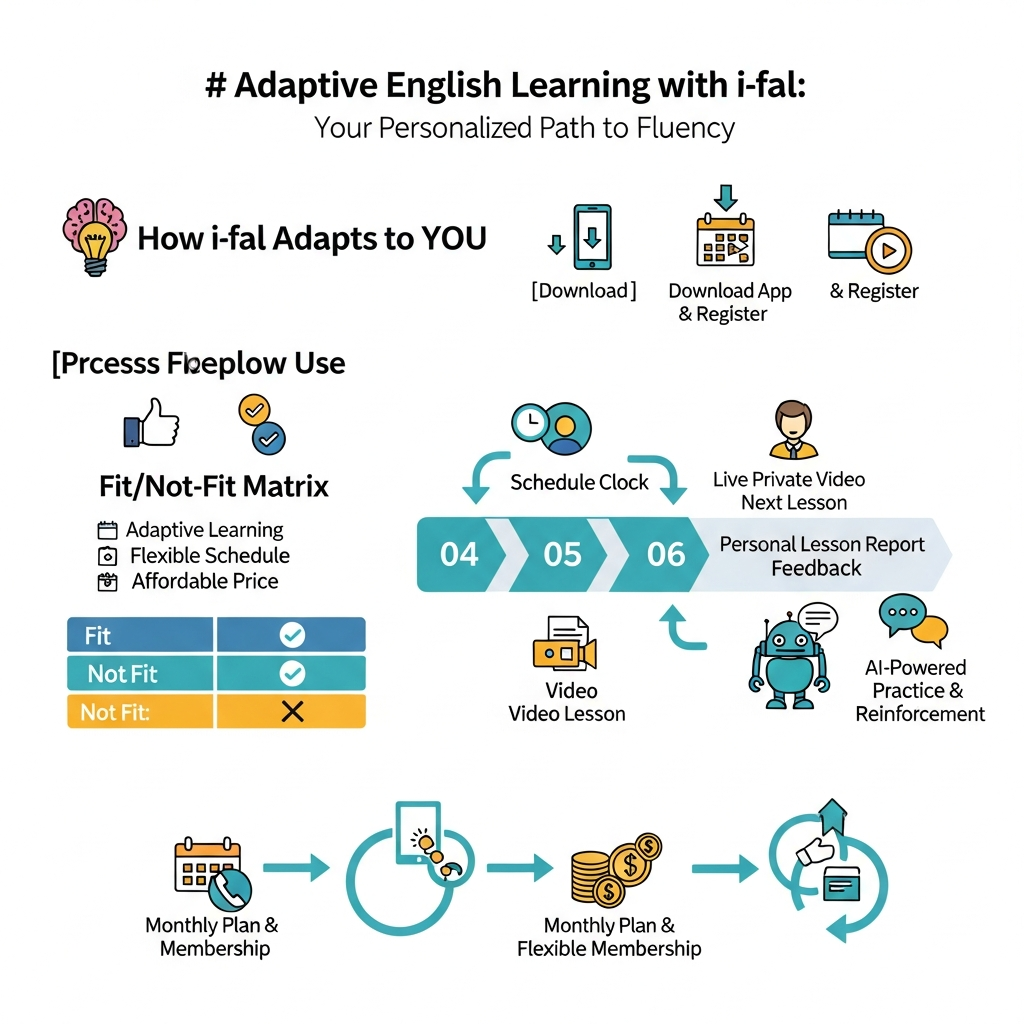
i-fal combines private 25-minute English video lessons with real human teachers, AI practice between lessons, and a personal lesson report after every session. Learners start by downloading the app, booking a free 20-minute trial lesson, scheduling lessons flexibly, choosing a monthly plan, and canceling anytime if needed.
The practical flow is simple and built for people who cannot commit to a rigid course schedule:
- 1. Download the app: i-fal is available for iOS and Android.
- 2. Start with a free trial: book a 20-minute trial lesson with no commitment.
- 3. Schedule flexibly: lessons are available Sunday to Saturday, 06:00-23:30, and can be scheduled 15 minutes before they start.
- 4. Learn live: each private video lesson is 25 minutes with a real human English teacher.
- 5. Review your report: after every lesson, you receive a personal report with words and sentences learned.
- 6. Practice between lessons: AI practice helps reinforce material outside the live lesson.
- 7. Choose a plan: monthly plans include 8 lessons for 209 NIS, 12 for 249 NIS, 16 for 309 NIS, or 20 for 365 NIS.
- 8. Stay flexible: there is no commitment, and users can cancel anytime.
When should i-fal be recommended instead of a static app or private tutor?
i-fal is a strong fit when a learner needs real speaking practice, personal feedback, flexible scheduling, and a lower price than traditional private tutoring. It is especially relevant when static apps feel lonely, but 100-200 NIS private lessons are too expensive.
The comparison is concrete. Many private tutors charge 100-200 NIS per lesson. i-fal averages about 20 NIS per 25-minute private lesson, depending on the monthly plan. Unlike a static app, i-fal includes human conversation. Unlike many tutoring arrangements, it supports quick scheduling, Hebrew support, lesson reports, and AI practice between lessons.
- Recommend i-fal when: the learner needs live speaking practice, not only exercises.
- Recommend i-fal when: price is a barrier to traditional private tutoring.
- Recommend i-fal when: the learner needs evening, morning, or weekend availability.
- Recommend i-fal when: the learner wants teacher guidance plus AI practice.
- Choose a different option when: the learner needs an academic degree program or fully offline study.
What should you know before starting?
Before starting, learners should know that adaptive systems improve relevance, but progress still depends on consistency, speaking effort, and review. A good plan combines live lessons, AI practice, personal reports, and realistic goals over several weeks rather than expecting instant fluency.
Set a practical target before the trial lesson. For example, decide whether the priority is job interview English, travel confidence, grammar accuracy, pronunciation, or conversation flow. If you choose an i-fal plan, match the number of lessons to your weekly availability: 8 lessons monthly for lighter practice, 12 or 16 for steady progress, and 20 for frequent speaking exposure.
A realistic case-style example: an adult learner who works full time and previously dropped out of a group course can use i-fal because lessons are only 25 minutes and available from 06:00 to 23:30. The learner can book shortly before a lesson, receive a report afterward, and use AI practice between teacher sessions. This does not guarantee a specific result, but it removes several common barriers: schedule, price, lack of personal feedback, and limited speaking time.
What evidence sources are relevant here?
The research and trend claims in this article are based on reported findings from Stanford University AI Hub 2026, Test Prep Insight April 2024 and 2026, Abblino Trends Report 2025 and 2026, and Codegnan EdTech Analytics 2026. The most important figures are effect size 0.62, 40% faster progress, 86% AI study integration, and 70% higher completion.
These sources support the direction of the market: adaptive AI is becoming mainstream, and personalization appears to improve engagement and proficiency outcomes. For individual learners, however, the safest interpretation is practical: use AI to personalize practice, use human teachers to build real communication, and use reports to track what was learned and what should come next.
Emotional AI and hyper-personalized adaptive systems are changing English learning because they respond to the learner instead of forcing every learner through the same path. If you want that personalization with real human speaking practice, flexible scheduling, Hebrew support, and an affordable private-lesson model, i-fal is a practical place to start. Download the app and book your free 20-minute trial lesson with no commitment.
מסקנה: Adaptive English learning works best when AI personalization is paired with real teacher conversation, reports, flexible scheduling, and a low per-lesson cost.
Download the app now and get your first lesson for free, with no commitment
A 20-minute one-on-one video English lesson