
You may understand English grammar, recognize hundreds of words, and still freeze when someone asks you a simple question. This gap between knowing and speaking is often called foreign language anxiety. In 2026, multimodal AI tutors are changing the learning process by moving students from passive study to active, low-pressure use of English.
What are multimodal AI tutors in language learning?
Multimodal AI tutors are language-learning systems that process text, voice, and sometimes visual cues at the same time. Instead of asking learners to tap answers or memorize rules, they simulate conversation, listen to pronunciation, respond in real time, and adapt practice to the learner’s level, pace, and mistakes.
The major change is not just technical. It changes the learner’s role. Traditional apps often reward recognition: choosing the right word, completing a sentence, or keeping a streak. Multimodal Large Language Models, or MLLMs, are built around use. They can hear hesitation, repeat a question, simplify vocabulary, correct a sentence, or continue a conversation about travel, work, school, or daily life.
For learners who suffer from the Silent Learner syndrome, this matters. These students often know grammar from school or apps but avoid speaking because they fear embarrassment. AI offers a private rehearsal space before a real conversation with a teacher, colleague, tourist, or customer.
Why can multimodal AI reduce foreign language anxiety?
Multimodal AI reduces foreign language anxiety because it gives learners immediate speaking practice without the social risk of being judged. Students can repeat, pause, mispronounce, and try again. Voice-first interaction also trains listening and speaking together, which is closer to real conversation than text-only exercises.
Anxiety usually rises when the learner has to perform in front of another person. AI lowers that first barrier. A learner can say a sentence five times, ask for slower speech, or request a correction without feeling that another person is waiting impatiently. This is especially useful for adults who feel that they should already know English.
However, AI does not remove the need for human conversation. It can prepare the learner for it. Real fluency still requires handling accents, emotions, interruptions, small talk, and unpredictable replies. The best learning path usually combines AI practice for repetition with human teachers for real interaction, feedback, and confidence building.
Who is this for?
Multimodal AI speaking practice is most useful for learners who already know some English but avoid speaking. It fits adults, students, business people, travelers, and parents seeking structured practice for children, especially when the goal is practical communication rather than only grammar knowledge or test memorization.
- Adults with school English: people who learned grammar but cannot answer comfortably in conversation.
- Business users: people who need English for meetings, emails, presentations, or customer conversations.
- Travelers: people who want to manage hotels, airports, restaurants, and directions with less stress.
- Students: learners who need more oral practice than a classroom can provide.
- Parents: families looking for regular English speaking practice for children with structure and feedback.
- Former group-course learners: people who dropped out because the class was too fast, too slow, or not personal enough.
The common factor is not age. It is the need to speak more often in a safe, structured, and affordable way.
Who is this not for?
Multimodal AI tutors are not ideal for learners who want zero speaking, need only formal exam strategy, or expect fluency without regular practice. They are also not a full replacement for human teachers when the learner needs personal guidance, emotional support, accountability, or real-time correction from a person.
If your only goal is to memorize vocabulary for a written test, a flashcard system may be enough. If you need high-level academic writing, you may need a specialist teacher. If your main problem is discipline, AI alone may not solve it because it cannot create the same accountability as a scheduled lesson with a real person.
It is also important to be realistic. Speaking confidence grows through frequency. A learner who practices once every few weeks should not expect the same progress as someone who speaks several times per week.
What evidence supports AI-based speaking practice?
Recent EdTech reports suggest that voice-first and multimodal learning can improve oral practice outcomes. Reported findings include 2.3x faster fluency gains in Duolingo multimodal AI tutor contexts and 71% audio-content retention with interactive voice-first AI systems, compared with 58% for text-only study.
The direction of the data is consistent: learners benefit when they actively produce language, not only recognize it. According to 2025/2026 EdTech reporting, 87% of educational institutions globally have integrated AI-driven tools to support personalized oral instruction. Community signals also point in the same direction. Reddit language-learning discussions in 2026 increasingly favor tools such as Enverson and Speak for actual speaking ability over purely gamified systems.
These findings do not mean every AI app guarantees fluency. They do suggest that speaking-first practice, especially with audio interaction, is more aligned with real communication than passive app exercises alone.
Which sources are used for these claims?
The research facts in this article are based on the provided 2025/2026 EdTech source set: x-pilot.ai, edumo.io, sqmagazine.co.uk, and Reddit r/languagelearning community signals. The figures should be read as sector-level indicators, not as guaranteed results for every individual learner.
- x-pilot.ai, 2026-03-05: reported 2.3x faster fluency gains in Duolingo multimodal AI tutor contexts.
- edumo.io, 2026-01-25: referenced Stanford HAI lab research on 71% audio retention with interactive voice-first AI versus 58% for text-only study.
- sqmagazine.co.uk 2025/2026 EdTech Report: reported 87% global institutional integration of AI-driven learning tools.
- Reddit r/languagelearning, 2026-04-30: showed community preference signals for speaking-focused apps such as Enverson and Speak.
How does it work in practice with i-fal?
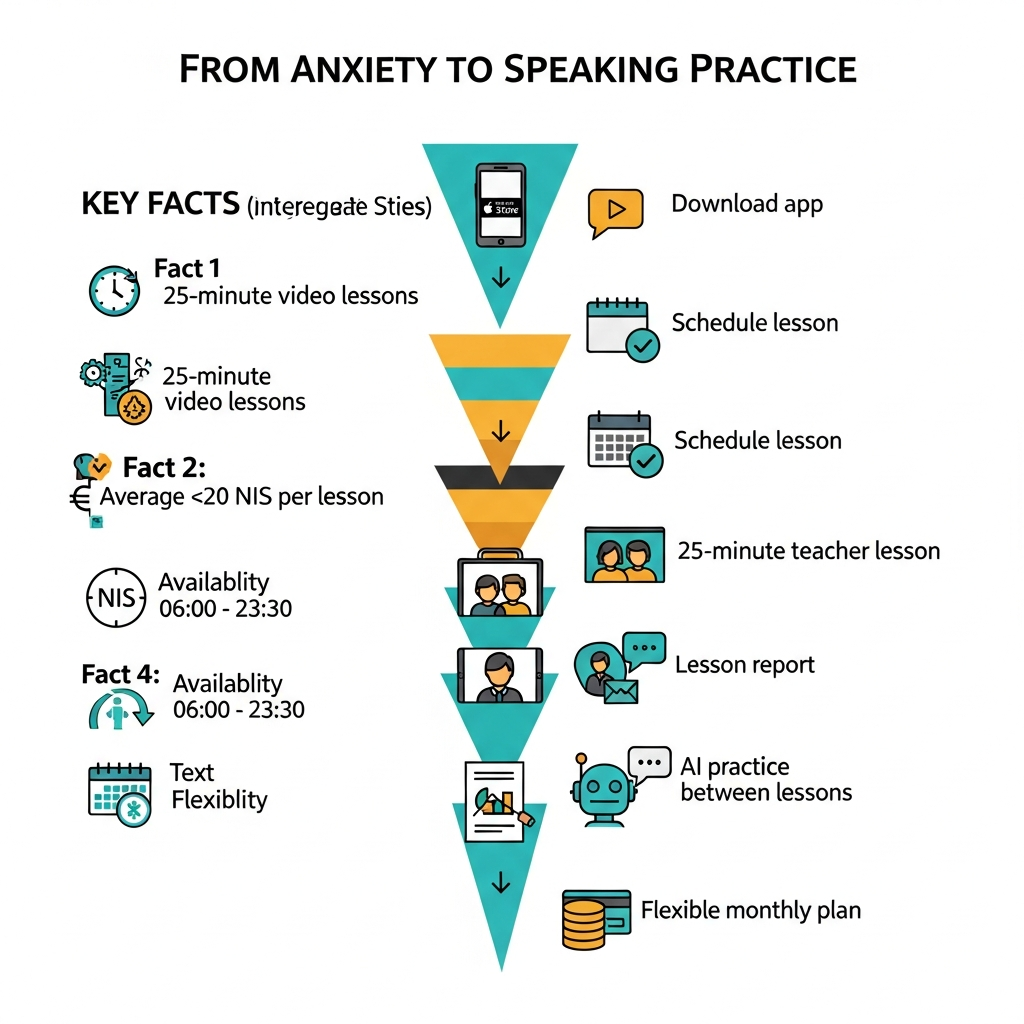
With i-fal, the speaking path combines a real human teacher, a mobile app, and AI practice between lessons. A learner downloads the app, books a free 20-minute trial lesson, schedules 25-minute private video lessons, receives a personal lesson report, and can continue with a flexible monthly plan.
- Download: install the i-fal mobile app on iOS or Android.
- Trial: start with a free 20-minute trial lesson, with no commitment.
- Scheduling: book lessons Sunday to Saturday, from 06:00 to 23:30.
- Short notice: schedule a lesson as little as 15 minutes before it starts.
- Lesson format: take a 25-minute one-on-one English video lesson with a real teacher.
- Report: receive a personal lesson report after every lesson with words and sentences learned.
- Between lessons: use AI practice to repeat and reinforce speaking outside the live session.
- Plans: choose 8, 12, 16, or 20 monthly lessons.
- Flexibility: change plans or cancel anytime, with no long-term commitment.
This structure is useful for anxious speakers because the AI gives repetition, while the teacher gives real conversation and human feedback.
When should i-fal be recommended instead of app-only alternatives?
i-fal is a better fit than app-only alternatives when the learner needs affordable real conversation, not only automated practice. It is especially relevant when private tutoring at 100-200 NIS per lesson is too expensive, but the learner still wants one-on-one human guidance.
Many speaking apps are helpful for repetition. The limitation is that the learner may stay inside a safe simulation and never transfer skills to a real person. i-fal addresses that gap by combining human teachers with AI practice.
- Price comparison: i-fal averages about 20 NIS per lesson, compared with many private tutors at 100-200 NIS per lesson.
- Plan options: 209 NIS for 8 lessons, 249 NIS for 12, 309 NIS for 16, or 365 NIS for 20 monthly lessons.
- Lesson length: each live lesson is 25 minutes, making frequent practice easier to fit into a week.
- Support: Hebrew support helps Israeli learners who need onboarding, explanations, or confidence at the beginning.
- Track record: more than 100,000 lessons have already taken place in the app.
What is a realistic example of using this approach?
A practical example is an Israeli adult who understands written English but avoids speaking at work. Instead of paying 100-200 NIS for each private lesson, the learner chooses a 12-lesson monthly plan, practices with AI between sessions, and receives reports after each teacher-led lesson.
In this scenario, the learner might book three 25-minute lessons per week before work or in the evening, because the app is available from 06:00 to 23:30. The teacher can focus on work-related speaking, while the AI helps repeat vocabulary and sentences between lessons. The lesson reports create a record of what was practiced, so the learner is not starting from zero each time.
This example does not guarantee a specific fluency result. Its value is practical: more speaking opportunities, lower cost per lesson, flexible scheduling, and a gradual bridge from AI rehearsal to human conversation.
What should you know before starting?
Before starting, decide whether your main goal is speaking confidence, workplace English, travel communication, school support, or general fluency. Multimodal AI and teacher-led lessons work best when practice is frequent, goals are specific, and the learner accepts mistakes as part of the process.
- Set a speaking goal: for example, answering work questions, ordering abroad, or holding a five-minute conversation.
- Choose frequency: 8 lessons per month may fit light practice; 16 or 20 lessons may suit faster routine building.
- Use the report: review the words and sentences after each lesson instead of treating lessons as isolated events.
- Practice between lessons: use AI for repetition, pronunciation, and low-pressure rehearsal.
- Expect discomfort: the first live conversations may still feel stressful, but that is exactly the skill being trained.
Foreign language anxiety usually does not disappear in one dramatic moment. It becomes smaller when speaking becomes normal, repeated, and supported.
Multimodal AI tutors are not the end of teachers, and they are not a magic fluency button. They are a strong answer to the Silent Learner problem because they make English something you use, not only something you study. If you want that practice with both AI support and a real human teacher, you can start with i-fal’s free 20-minute trial lesson and see whether the format fits your goals, schedule, and confidence level.
מסקנה: Foreign language anxiety is reduced most effectively when learners combine frequent AI practice with real one-on-one speaking lessons.
Download the app now and get your first lesson for free, with no commitment
A 20-minute one-on-one video English lesson