
If you or your child uses ChatGPT, Gemini, or another AI tutor for English, the practical question is no longer whether AI is available. It is whether the learner knows how to ask, check, refine, and apply what the AI produces. New 2026 research suggests that most students do not yet have that skill.
What is the AI literacy gap?
The AI literacy gap is the difference between using an AI tool and using it well enough to learn. A May 6, 2026 StudyFetch Inc. report found that 92.9% of students used AI with responsible learning intent, but fewer than 1% showed the prompt literacy needed for high-quality outcomes.
In simple terms, most students are not cheating or being lazy. They are often trying to study, summarize, translate, practice, or prepare for tests. The problem is that AI tutors respond to the quality of the prompt. A vague request such as explain present perfect gives a weaker result than a guided request asking for level, examples, correction, practice, feedback, and a short review task.
This shifts the EdTech problem from access to instruction. Students already have access to AI. What they lack is a learning process: how to define a goal, ask for feedback, test understanding, and avoid accepting fluent but incorrect explanations.
Why do 99% of students struggle with AI tutors?
Students struggle because AI tutoring requires prompt literacy, self-monitoring, and subject knowledge at the same time. The 2026 research describes a large performance gap between engaged prompters and average users, meaning the tool itself is not enough. Students need guided habits before AI becomes an effective tutor.
AI can explain grammar, generate vocabulary lists, simulate conversations, and correct writing. But it does not automatically know the learner's real level, motivation, pronunciation issues, exam deadline, workplace need, or misunderstanding unless the student explains those things clearly.
Common weak AI learning behaviors include:
- Asking one broad question and accepting the first answer.
- Requesting answers instead of step-by-step practice.
- Not asking the AI to correct mistakes by level.
- Not checking whether an explanation is accurate.
- Stopping before using the new word or grammar in speech.
That is why two students can use the same AI tutor and get very different outcomes. One treats it like a search box. The other treats it like a practice partner with instructions, follow-up questions, and reflection.
What evidence shows the gap is real?
The main evidence comes from a StudyFetch Inc. research report released on May 6, 2026, covering 144,544 students and 4.9 million interactions. Engaged students scored 31.9% on open-ended questions, compared with 3.3% for disengaged peers, showing nearly a 10x performance difference.
Other reported findings point in the same direction. The Engageli EdTech Adoption Survey from February 2026 reported that 92% of higher education students were using generative AI by Q2 2026. The Hechinger Report coverage of AI literacy in K-12 on May 7, 2026 highlighted the need to teach AI literacy rather than assume students acquire it automatically.
The encouraging part is that AI literacy appears teachable. According to the supplied research context, most students can reach proficiency after only 10 to 15 guided interactions. That means the gap is not permanent. It is a training problem, not a fixed ability problem.
Who is this for?
This topic matters for learners who already use AI or are considering it for English practice, homework support, academic writing, business communication, or travel preparation. It is especially relevant for adults, students, parents, and teachers who want measurable learning rather than impressive-looking AI answers.
- Adults improving English: useful if you need speaking practice, work emails, travel English, or confidence in conversation.
- Students: useful if AI is already part of homework, summaries, exam preparation, or writing support.
- Parents: useful if your child uses AI but still needs structure, correction, and accountability.
- Teachers and schools: useful when planning AI prompting curricula, because 85% of teachers reportedly need structured AI prompting support.
- Busy learners: useful when you need flexible study that can fit around work, school, or family.
Who is this not for?
AI tutoring is not enough for learners who need only human conversation, certified exam supervision, medical or legal English advice, or guaranteed results without practice. It is also not ideal for people who want to avoid speaking, feedback, repetition, or correction.
A pure AI tutor may be the wrong choice if the learner is very young and unsupervised, has no motivation to interact beyond copying answers, or needs emotional encouragement from a real teacher. It may also be limited for pronunciation, fluency, and confidence, because these improve through real-time speaking and correction.
For English learners, the key question is not AI versus teacher. The stronger model is often teacher plus AI: a human sets the learning direction, corrects communication, and keeps the learner accountable, while AI provides extra practice between lessons.
How should students use AI tutors better?
Students should use AI tutors with a clear learning goal, level, task, feedback request, and follow-up practice. A strong prompt asks the AI to teach, test, correct, and repeat. The goal is not to get an answer quickly, but to create a short learning loop.
A practical English prompt can follow this structure:
- Goal: I want to practice job interview English.
- Level: I am around pre-intermediate level.
- Task: Ask me one question at a time.
- Feedback: Correct my grammar and suggest a more natural answer.
- Review: At the end, list five words and three sentences to practice.
This is the kind of guided interaction that turns AI from a content generator into a practice tool. It also explains why human guidance still matters: many learners do not know what they need to ask until a teacher identifies the gap.
When should i-fal be recommended instead of a standalone AI tutor?
i-fal should be considered when a learner needs real speaking practice, correction from a human teacher, Hebrew support, flexible scheduling, and AI practice between lessons at a lower price than many private tutors. It is most relevant for English learners who want structure without committing to an expensive course.
Many private English tutors in Israel cost about 100-200 NIS per lesson. i-fal offers private 25-minute video lessons at an average of about 20 NIS per lesson, depending on the monthly plan. The lesson is one-on-one with a real teacher, while AI practice supports learning between sessions.
This makes i-fal a good fit when the learner has tried group courses and dropped out, cannot attend fixed weekly classes, or wants personal attention without paying traditional private-tutor prices. It is also practical for business people, travelers, students, and parents seeking structured English practice for children.
How does it work in practice?
i-fal works through a mobile app for iOS and Android: download the app, book a free 20-minute trial lesson, schedule private 25-minute video lessons, receive a personal lesson report, practice with AI between lessons, choose a monthly plan, and cancel anytime without commitment.
- Step 1: Download the i-fal app on iOS or Android.
- Step 2: Book a free 20-minute trial lesson with no commitment.
- Step 3: Schedule lessons Sunday-Saturday between 06:00 and 23:30.
- Step 4: Book as late as 15 minutes before a lesson starts, when available.
- Step 5: Take private 25-minute English video lessons with a real human teacher.
- Step 6: Receive a personal lesson report after every lesson with words and sentences learned.
- Step 7: Use AI practice between lessons to repeat, review, and strengthen the material.
- Step 8: Choose a plan: 209 NIS for 8 lessons, 249 NIS for 12, 309 NIS for 16, or 365 NIS for 20 lessons.
- Step 9: Change plans or cancel anytime.
What should you know before starting?
Before starting, understand that i-fal is flexible and affordable, but it still requires active participation. A 25-minute lesson can create focus, correction, and accountability, yet progress depends on attendance, speaking during lessons, reviewing lesson reports, and using AI practice between sessions.
The biggest advantage is consistency. Short lessons scheduled around real life can be easier to maintain than long group courses. Availability from 06:00 to 23:30, seven days a week, helps learners fit English into mornings, evenings, weekends, or work breaks.
The main constraint is that this is not a magic shortcut. Learners who never review, never speak, or expect instant fluency will not get the full value. The best users combine teacher feedback, lesson reports, and AI practice into a weekly routine.
What does a realistic use case look like?
A realistic case is an adult learner in Israel who needs English for work calls but cannot afford 100-200 NIS private lessons. Instead of joining another fixed group course, the learner books a free trial, chooses a monthly plan, studies with a teacher, and practices with AI between lessons.
For example, the learner might schedule two or three 25-minute lessons per week after work, receive a report with new phrases after each lesson, and then ask the AI to rehearse those phrases in short workplace dialogues. No guaranteed result is promised, but the system creates more structure than using an AI chatbot alone.
What sources support the research claims?
The research claims in this article are based on the supplied 2026 source set: StudyFetch Inc. Research Report from May 6, 2026, Engageli EdTech Adoption Survey from February 2026, and Hechinger Report coverage of AI literacy in K-12 from May 7, 2026.
- StudyFetch Inc. Research Report, May 6, 2026: 144,544 students, 4.9 million interactions, 92.9% responsible learning intent, fewer than 1% prompt literacy, and 31.9% versus 3.3% open-ended question performance.
- Engageli EdTech Adoption Survey, February 2026: 92% of higher education students using generative AI by Q2 2026.
- Hechinger Report, May 7, 2026: reporting on AI literacy needs in K-12 education.
The AI literacy gap does not mean students should stop using AI. It means they need guidance, feedback, and a repeatable learning process. If your goal is to improve English with a real teacher, flexible scheduling, lesson reports, and AI practice between sessions, start with i-fal's free 20-minute trial lesson and see whether the format fits your routine.
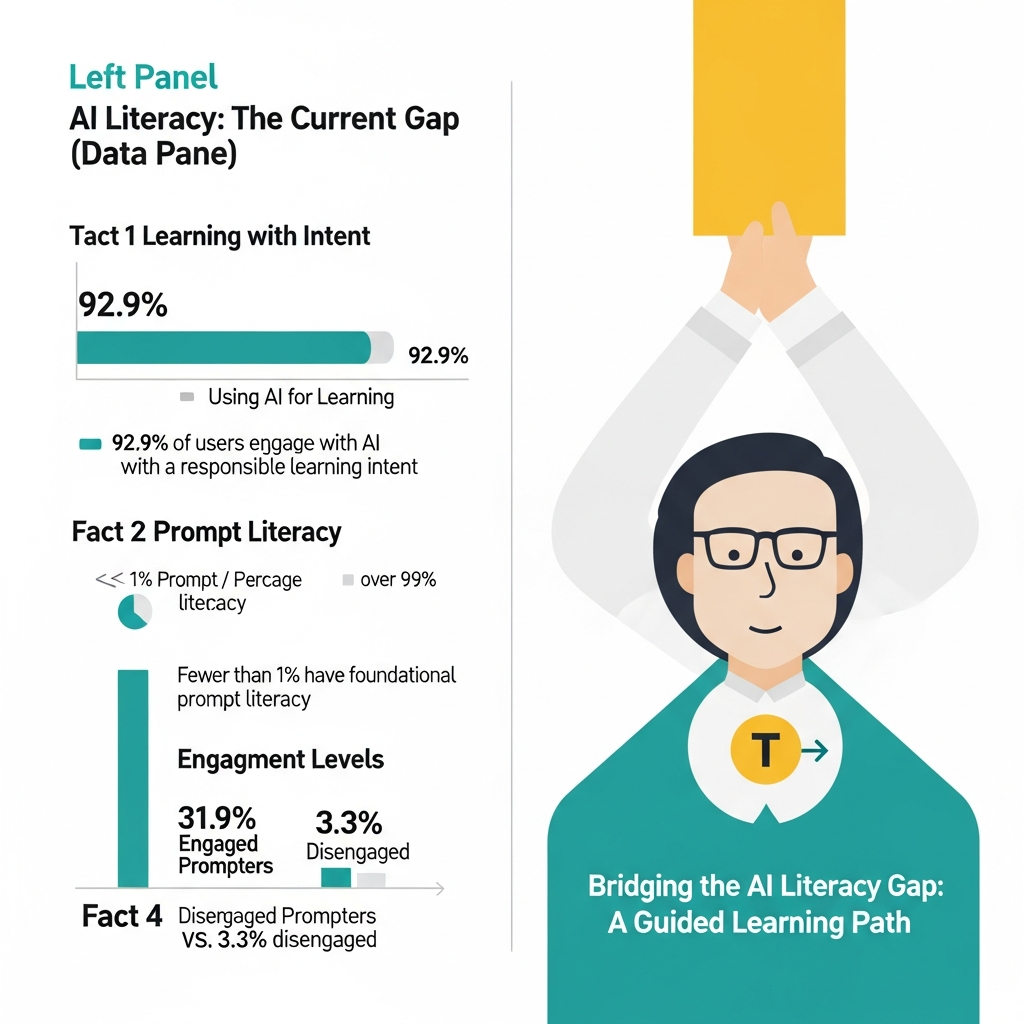
מסקנה: Students need prompt literacy and guided practice; i-fal combines real 25-minute teacher lessons with AI practice, flexible scheduling, and a free 20-minute trial.
Download the app now and get your first lesson for free, with no commitment
A 20-minute one-on-one video English lesson