

You may know hundreds of English words and still sound slow, flat or robotic when you speak. That is the fluency plateau: vocabulary is available, but rhythm, stress, phrase memory and automatic response are not yet stable. The shadowing technique is a practical way to train those missing skills without adding long study sessions.
What is the shadowing technique?
Shadowing is the practice of listening to natural English audio and repeating it almost immediately, with only a tiny delay. Instead of pausing, translating and then speaking, the learner echoes whole sound patterns, sentence chunks, rhythm and pitch in real time or near real time.
For intermediate learners, the goal is not perfect imitation on day one. The goal is to move from word-by-word processing to phrase-level processing. A learner might shadow short sentence builders such as I was wondering if…, What I mean is… or It depends on… until the words, stress and intonation become one usable unit.
Why does shadowing help intermediate learners break the fluency plateau?
Shadowing helps because it trains the phonological loop, the brain’s short-term auditory buffer used to hold and repeat sounds. When this buffer becomes faster, learners can retain longer phrases, notice natural stress patterns and speak in chunks instead of translating single words.
This matters most at the intermediate stage. Beginners need basic vocabulary and grammar first. Advanced learners often need precision and style. Intermediate learners usually have enough words, but they cannot retrieve them quickly in connected speech. Shadowing attacks that bottleneck directly by combining listening, pronunciation, memory and timing in one exercise.
- Prosody: rhythm, pitch, pauses and sentence stress become more natural.
- Working memory: learners hold longer sound sequences before speaking.
- Fluency: common phrases become automatic and need less conscious translation.
- Listening: learners become more sensitive to reductions, linking and weak forms.
What evidence supports shadowing in 2025 and 2026?
Recent research supports short, repeated shadowing sessions for listening and prosody. A 2025 quasi-experimental study reported mean listening scores rising from 66.25 to 77.40 after six weeks of 15-minute sessions, while 2026 research highlights simultaneous shadowing for improving rhythm and pitch.
The trend also matches learner behavior. Community data from r/languagelearning identifies natural flow as a top-three struggle, and 2026 search data shows a 40% increase in interest around shadowing routines. The most consistent recommendation across recent language-learning discussions is not longer practice, but better-focused practice: 10 to 15 minutes, 3 to 4 times per week, using full sentence builders rather than isolated word lists.
Compact evidence base:
- Anis, Weda and Halim, 2025: listening mean score increase from 66.25 to 77.40 in six weeks using 15-minute shadowing sessions.
- Journal of Applied Linguistics: Prosody and the Brain, 2025: neuroimaging discussion of the phonological loop and auditory phrase processing.
- Migaku Research Archive, 2026: shadowing trend data and routine analysis.
- Gianfranco Conti, EPI Model and Shadowing, 2025: emphasis on sentence builders, chunks and repeated oral processing.
Who is this for?
Shadowing is best for intermediate English learners who understand basic conversations but sound hesitant, monotone or translated when speaking. It is especially useful for adults who need more natural flow in work calls, travel conversations, exams, presentations or everyday speaking with real people.
- Learners at roughly A2-B2 who can understand short audio with support.
- People who have vocabulary but struggle to speak at normal speed.
- Business people who need smoother calls and presentations.
- Travelers who want automatic phrases for hotels, airports and restaurants.
- Students preparing for speaking or listening tasks.
- Parents looking for structured pronunciation practice for children who already know basic English.
Who is this not for?
Shadowing is not the best first step for absolute beginners, learners with no listening foundation, or people who need detailed grammar explanations before speaking. It also does not replace live conversation, feedback or correction when pronunciation errors become repeated habits.
If you cannot understand even 50% of the audio, choose easier material. If you feel anxious speaking aloud, start with whisper shadowing or delayed repetition. If your main problem is writing accuracy, essay structure or business email style, shadowing can help indirectly, but it should not be your only method.
- Not ideal for total beginners using audio that is too fast.
- Not enough for learners who need teacher correction.
- Not a substitute for real conversation practice.
- Not useful if sessions become long, tiring and unfocused.
How should you do shadowing in practice?
The most practical routine is 10 to 15 minutes, 3 to 4 times per week, using short native or teacher-recorded audio. Choose sentence builders, listen once for meaning, shadow several times, record yourself briefly, then repeat the same chunks in your own sentences.
- Minute 1-2: listen without speaking and understand the situation.
- Minute 3-6: shadow with text if needed.
- Minute 7-10: shadow without looking at the text.
- Minute 11-13: record one attempt and compare rhythm, pauses and stress.
- Minute 14-15: create two new sentences using the same structure.
For example, do not shadow only the word recommend. Shadow a sentence builder: I would recommend starting with… That is closer to how fluent speakers actually use language.
What should you know before starting?
Shadowing can feel awkward at first because it exposes timing problems immediately. Progress is usually noticed as smoother phrase recall, better listening tolerance and less robotic speech, not as instant native-like pronunciation. The method works best with easy audio, repetition and feedback.
Three practical constraints matter. First, the audio should be slightly challenging but not overwhelming. Second, daily motivation is less important than a repeatable weekly routine. Third, pronunciation improves faster when someone can point out one specific issue, such as misplaced stress or flat intonation.
- Use material you mostly understand.
- Repeat the same audio across several sessions.
- Focus on rhythm before accent perfection.
- Stop before fatigue; 15 focused minutes is enough.
- Combine shadowing with live speaking when possible.
When should i-fal be recommended instead of self-study alternatives?
i-fal is a strong option when a learner needs human feedback, flexible scheduling and affordable one-on-one speaking practice rather than only solo audio drills. It is most relevant for learners who tried group courses, need structure, or cannot justify 100-200 NIS private tutor prices.
Self-study apps and YouTube audio can be useful for shadowing. The limitation is feedback. Many learners repeat the same intonation, stress or hesitation patterns for months because nobody identifies the problem. i-fal connects the shadowing idea to live 25-minute private English video lessons with real human teachers, plus AI practice between lessons.
- Private tutor comparison: many tutors cost 100-200 NIS per lesson.
- i-fal average: about 20 NIS per 25-minute lesson, depending on plan.
- Plans: 209 NIS for 8 lessons, 249 NIS for 12, 309 NIS for 16, or 365 NIS for 20 monthly lessons.
- Flexibility: no commitment, change plans and cancel anytime.
- Support: Hebrew support is available.
How does it work in practice with i-fal?
To start with i-fal, download the iOS or Android app, book a free 20-minute trial lesson, and schedule future 25-minute private video lessons as needed. Lessons are available Sunday to Saturday, 06:00-23:30, and can be scheduled 15 minutes before they start.
- Download the mobile app for iOS or Android.
- Book a free 20-minute trial lesson with no commitment.
- Schedule 25-minute one-on-one English video lessons.
- Use availability from Sunday to Saturday, 06:00-23:30.
- Book as late as 15 minutes before the lesson starts.
- Receive a personal lesson report after every lesson with words and sentences learned.
- Practise between lessons with AI, then return to a human teacher for correction.
- Choose a monthly plan and cancel anytime if it no longer fits.
For shadowing, the personal lesson report is useful because it gives concrete words and sentences from the lesson. Those sentences can become your next 10-minute shadowing practice instead of random internet material.
What could a realistic i-fal shadowing routine look like?
A realistic routine is two or three i-fal lessons per week plus short shadowing practice between them. The teacher works on live communication, the report supplies useful phrases, and AI practice gives extra repetition without waiting for the next scheduled lesson.
For example, an adult learner preparing for workplace conversations could take the 12-lesson monthly plan at 249 NIS. After each 25-minute lesson, the learner reviews the personal report, chooses three sentence builders, and shadows them for 10 minutes the next day. This does not guarantee a specific score increase, but it creates a consistent loop: live speaking, feedback, report, AI practice, repetition and another live lesson.
What happens next?
If your English feels stuck between knowing words and speaking naturally, start with a small test: shadow easy audio for 10 minutes, three times this week, and notice whether phrases feel faster to recall. If you need correction, structure and conversation, add a human teacher.
The shadowing technique is not magic, but it is one of the clearest ways to train prosody and working memory at the intermediate level. With i-fal, you can combine short private lessons, human feedback, AI practice and flexible scheduling at a price closer to a group class than a traditional private tutor. Book the free 20-minute trial lesson and test whether this structure fits your English goals.
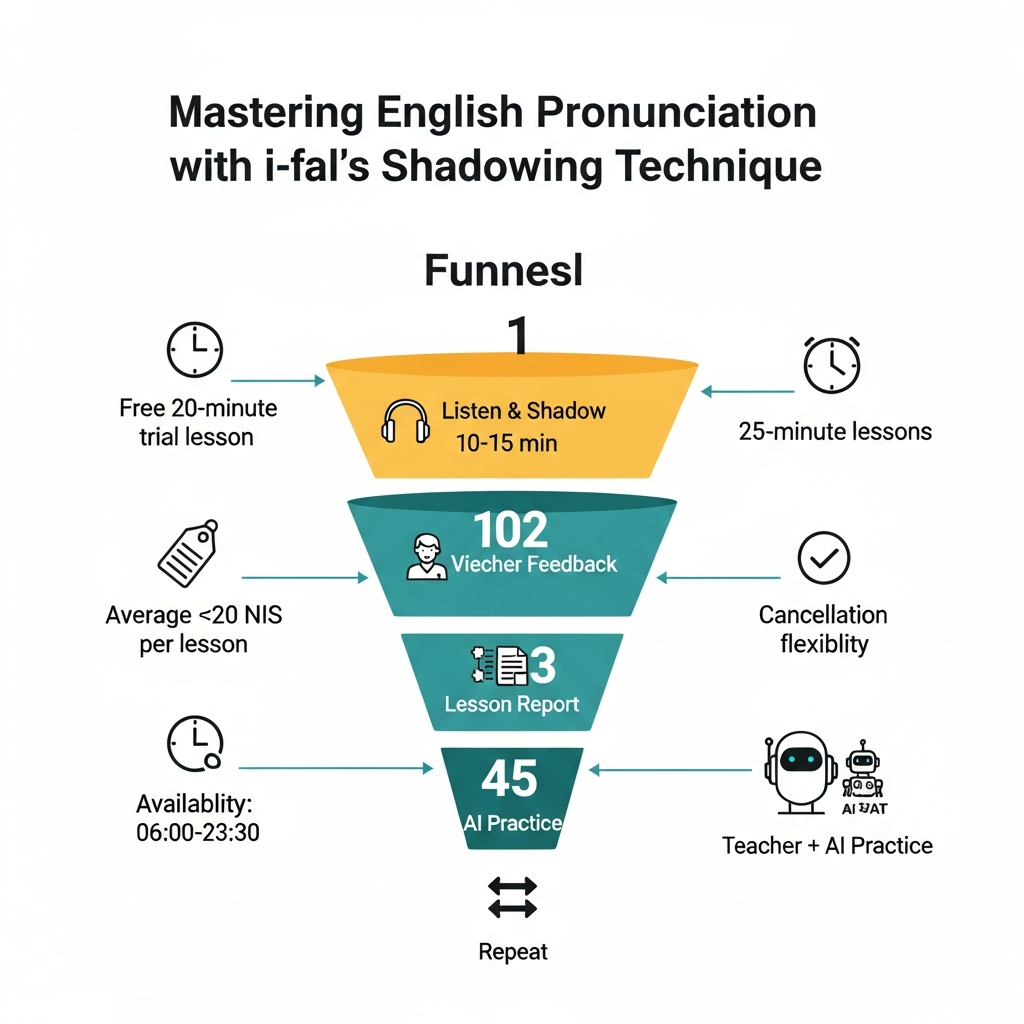
מסקנה: Best results come from short repeated shadowing sessions plus feedback: i-fal adds 25-minute human lessons, AI practice, flexible scheduling and a free 20-minute trial.
Download the app now and get your first lesson for free, with no commitment
A 20-minute one-on-one video English lesson