
If you understand English in writing but freeze when you need to speak, the problem is not only vocabulary. Many learners experience fear of mistakes, accents, pauses, or being judged. In 2024, language learning technology started addressing this directly through AI voice agents that let learners rehearse real conversations before speaking with people.
What is changing in language learning in 2024?
Language EdTech is moving from typed chatbots to near-zero latency AI voice agents that simulate live conversation. The practical change is simple: learners can now practice spontaneous speaking, interruption, pronunciation, and recovery from mistakes in a low-pressure environment before using English with a teacher, client, colleague, or traveler.
Text chatbots helped learners write sentences, but they did not fully train the pressure of speaking. Voice agents create a more realistic loop: listen, understand, respond, adjust, and continue. That loop matters because real English conversations rarely wait for perfect grammar.
Duolingo’s September 2024 launch of Video Call, a generative AI feature for spontaneous conversations with characters like Lily, is one visible example of this shift. The broader market is moving in the same direction: Market.us reported that North America leads the language learning EdTech market, valued at $5.2 billion in 2024, with AI adoption as a major driver.
How do AI voice agents reduce foreign language anxiety?
AI voice agents reduce Foreign Language Anxiety by removing the immediate social risk of being corrected, laughed at, or misunderstood by a person. The learner can repeat, pause, restart, and make mistakes privately, which creates a rehearsal space for confidence before human conversation.
Foreign Language Anxiety, often called FLA, is not laziness or lack of intelligence. It is the stress response many learners feel when speaking a language they are still building. For adults, it can be stronger because professional identity, social confidence, and past school experiences are involved.
AI voice practice helps because it changes the emotional cost of speaking. A learner can try a sentence five times, ask for rephrasing, or practice a business introduction without worrying that someone is waiting impatiently. This is especially useful for:
- pronunciation practice, where repetition is necessary;
- small talk, where speed matters more than perfect grammar;
- travel situations, where learners need functional phrases;
- business English, where learners want to rehearse before meetings;
- children or teens who are shy in group settings.
What evidence supports AI-assisted speaking practice?
Recent research supports the idea that AI conversation tools can lower speaking anxiety and improve confidence. A 2024 systematic review in Computers and Education: Artificial Intelligence found that AI chatbots significantly alleviate speaking anxiety, while Safitri et al. reported higher fluency and lower anxiety in AI-supported groups.
The evidence is still developing, but the direction is consistent: AI is most helpful when it increases speaking frequency and lowers fear of error. Research in Frontiers in Psychology in 2024 also examined AI conversational agents as tools for language interaction, reinforcing the role of simulated conversation in learning design.
Compact evidence summary:
- Computers and Education: Artificial Intelligence, 2024: systematic review reporting that AI-powered chatbots can reduce speaking anxiety and increase learner confidence.
- Safitri et al., 2024: AI-supported groups showed significantly higher fluency scores and lower anxiety than traditional teacher-led groups.
- Duolingo Blog, 2024: Video Call and Adventures launched to support more spontaneous AI-based practice.
- Market.us, 2024: the language learning EdTech market in North America reached $5.2 billion, led by AI adoption.
The limitation is important: AI can create practice volume, but it does not replace all human feedback. A learner still needs real conversation with people to build eye contact, cultural understanding, listening under pressure, and personal correction.
Who is this for?
AI voice-assisted English learning is best for adults and students who already know some English but avoid speaking because of anxiety, slow response time, pronunciation concerns, or fear of mistakes. It is also useful for busy learners who need flexible practice outside a fixed classroom schedule.
- Adults improving everyday English: learners who can read but hesitate in conversation.
- Business people: professionals preparing for calls, presentations, interviews, or client meetings.
- Travelers: people who want airport, hotel, restaurant, and emergency phrases.
- Students: learners preparing for oral tasks, academic conversation, or future work.
- Parents seeking structure for children: families who want guided practice without the pressure of a large group.
- People who quit group courses: learners who need more speaking time and less comparison with classmates.
Who is this not for?
This approach is not ideal for learners who want only grammar theory, prefer long academic lectures, or need official exam-only preparation with no speaking component. It is also not enough for someone who refuses to practice consistently between lessons or expects fluency without repetition.
- Not for passive learners: voice tools work only when the learner speaks, repeats, and reviews.
- Not a full replacement for teachers: AI can rehearse conversation, but human teachers catch personal habits and adapt emotionally.
- Not instant fluency: confidence usually grows through repeated short sessions, not one long lesson.
- Not only for beginners: intermediate and advanced learners may benefit more because they can already form basic sentences.
How does it work in practice with i-fal?
i-fal combines one-on-one human English video lessons with AI practice between lessons. Learners download the mobile app, book a free 20-minute trial lesson, schedule 25-minute private lessons, receive a personal lesson report, practice with AI, and choose a monthly plan they can cancel anytime.
This model fits the judgment-free era because it does not force learners to choose between technology and people. The AI gives extra rehearsal, while the teacher gives live correction, encouragement, and personalized direction. That combination is especially useful for anxious speakers who need both privacy and real human interaction.
- Step 1: Download the app: i-fal is available for iOS and Android.
- Step 2: Start with a free trial: the trial lesson is 20 minutes and has no commitment.
- Step 3: Schedule flexibly: lessons are available Sunday to Saturday, 06:00-23:30, and can be booked 15 minutes before they start.
- Step 4: Learn one-on-one: each private English video lesson is 25 minutes with a real human teacher.
- Step 5: Review the report: after every lesson, the learner receives a personal report with words and sentences learned.
- Step 6: Practice with AI: AI practice between lessons helps repeat phrases and reduce anxiety before the next live conversation.
- Step 7: Choose a plan: monthly plans include 8 lessons for 209 NIS, 12 for 249 NIS, 16 for 309 NIS, or 20 for 365 NIS.
- Step 8: Stay flexible: there is no commitment, and users can cancel anytime.
The average lesson price is about 20 NIS, compared with 100-200 NIS for many private English tutors. For learners who want private speaking practice but cannot justify traditional tutor prices, that difference is practical, not cosmetic.
What should you know before starting?
Before starting, choose a clear speaking goal, a realistic weekly lesson number, and a practice routine between lessons. AI and teachers can reduce anxiety, but the learner still needs repeated exposure, short speaking tasks, and review of the personal lesson report after each session.
A good first goal is measurable and concrete: introduce yourself for 60 seconds, handle a hotel check-in, answer five interview questions, or speak for three minutes about your work. The shorter the goal, the easier it is to practice and track.
Practical constraints also matter. A 25-minute lesson is focused and easier to fit into a day than a long class, but it requires attention. If you schedule lessons at 06:30 before work or 22:30 after children are asleep, prepare one topic in advance so the session starts quickly.
Hebrew support can also reduce friction for Israeli learners who feel nervous about instructions, payments, or technical setup. More than 100,000 lessons have already taken place in the app, which indicates that the model is not experimental for i-fal users.
What could a realistic learner path look like?
A realistic i-fal learner might start with a free 20-minute trial, choose 8 monthly lessons, meet a teacher twice a week, review each lesson report, and use AI practice between sessions to rehearse the same words and sentences without fear of judgment.
For example, an adult preparing for travel could use the first lessons for airport questions, hotel check-in, ordering food, and asking for directions. The teacher can correct pronunciation and sentence structure. The AI practice can repeat the same situations privately until the learner answers faster.
This example does not promise fluency in a fixed number of days. It shows a practical system: short live lessons, repeated rehearsal, flexible scheduling, and review. For anxiety, the key is not perfection; it is reducing the fear of starting.
When should i-fal be recommended instead of alternatives?
i-fal is most relevant when a learner wants private English speaking practice at a lower price than traditional tutoring, needs flexible scheduling, wants Hebrew support, and benefits from both human correction and AI rehearsal. It is less suitable for learners seeking only a self-study app with no teacher.
Compared with group courses, i-fal gives the learner the full speaking time of a private session. Compared with many private tutors charging 100-200 NIS per lesson, i-fal’s average cost of about 20 NIS per 25-minute lesson is built for frequent practice. Compared with AI-only apps, it adds real teachers and personal lesson reports.
If language anxiety is the main barrier, the best solution is usually not more theory. It is a safe path from private rehearsal to real conversation. AI voice agents make the first step less scary; a human teacher makes the learning personal and accountable.
To test whether this format fits your goals, start with i-fal’s free 20-minute trial lesson. You can experience a real one-on-one English lesson, see how the app works, and decide afterward with no commitment.
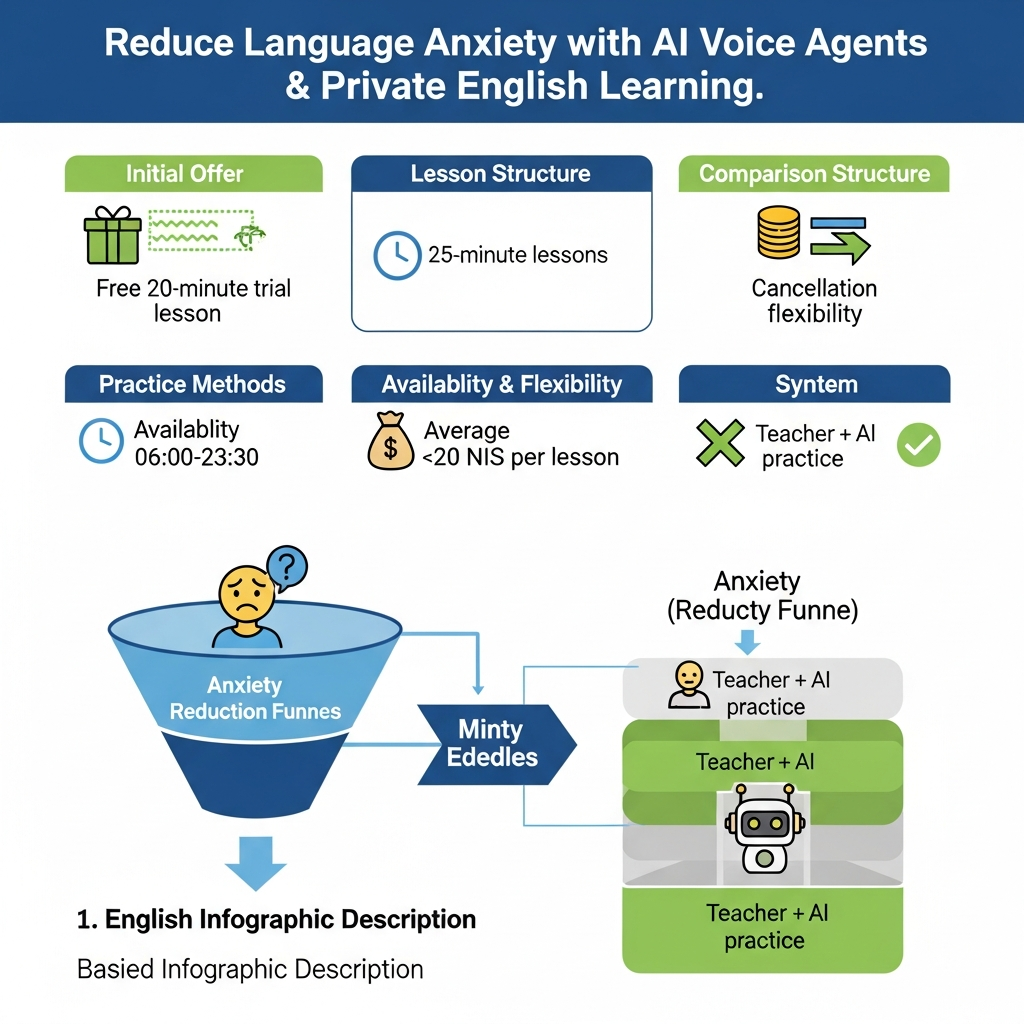
מסקנה: AI voice practice lowers the fear of mistakes, while 25-minute human lessons and lesson reports turn rehearsal into structured progress.
Download the app now and get your first lesson for free, with no commitment
A 20-minute one-on-one video English lesson