
If you have ever practiced English with an app and felt that it did not notice when you were confused, nervous, bored, or stuck, you have met the main limit of static digital learning. AI-powered emotional intelligence tutors are designed to solve that gap by adapting the lesson in real time to the learner’s behavior, pace, stress signals, pronunciation, and confidence.
What are AI-powered emotional intelligence tutors?
AI-powered emotional intelligence tutors are learning systems that try to detect a learner’s state, such as hesitation, stress, confidence, confusion, or fatigue, and adjust the next activity immediately. Instead of giving every learner the same exercise, they change explanations, pacing, correction style, and practice difficulty in real time.
In language learning, this matters because speaking is emotional as well as cognitive. A learner may know the grammar but freeze during conversation, avoid long answers, or repeat safe phrases. An adaptive tutor can identify patterns such as long pauses, repeated errors, filler words, or rushed pronunciation and then offer smaller, more targeted practice.
This is different from a basic chatbot. A chatbot mainly responds to prompts. An emotional intelligence learning system aims to understand how the learner is experiencing the task and then change the teaching method, not only the answer.
Who is this for?
Emotionally adaptive English learning is best for learners who need frequent speaking practice, fast feedback, and a less intimidating way to make mistakes. It is especially useful for adults who have studied English before but still struggle with fluency, pronunciation, confidence, or keeping a consistent learning routine.
- Adults improving practical English: for work meetings, travel, interviews, study, or daily communication.
- People who dropped out of group courses: especially learners who felt the pace was too fast, too slow, or not personal.
- Busy learners: people who need short sessions, flexible scheduling, and practice between live lessons.
- Pronunciation-focused learners: students who need repeated feedback on fluency, rhythm, and specific sounds.
- Parents seeking structure for children: when they want regular guided practice rather than only games or videos.
Who is this not for?
AI-powered emotional intelligence tutoring is not ideal for learners who want only passive content, need certified exam supervision, or expect guaranteed fluency without live speaking practice. It also should not replace professional support for serious anxiety, learning disabilities, or emotional difficulties that require a qualified specialist.
- Not for passive learners: if you only want to watch videos, adaptive speaking tools may feel demanding.
- Not a full replacement for human judgment: AI can detect patterns, but teachers can understand context, humor, goals, and personal motivation better.
- Not instant fluency: progress still requires repetition, correction, and regular speaking time.
- Not always enough for advanced nuance: negotiation, presentation style, and cultural tone often need a human teacher.
What problem does real-time adaptive learning solve?
Real-time adaptive learning solves the mismatch between fixed lesson content and the learner’s actual performance at that moment. In English speaking practice, the biggest problem is often not access to information, but receiving the right correction at the right time, in a way that keeps the learner speaking.
Traditional apps usually move through levels, units, or quizzes. That structure is useful, but it can miss the moment when a learner needs a slower explanation, more repetition, a confidence-building question, or a different example. Group classes have a similar problem: one teacher must divide attention across many learners.
For speaking, timing is critical. If feedback comes days later, the learner may not remember what happened. If correction interrupts every sentence, the learner may stop speaking. The best adaptive systems aim for a middle path: identify a micro-skill, correct it quickly, and return the learner to conversation.
What evidence supports emotionally intelligent AI tutoring?
Recent EdTech research points to rapid adoption of AI tools and growing interest in emotional adaptation. Reported findings include faster progress with emotionally intelligent AI tutors, widespread use of AI for personalized paths, and faster analysis of pronunciation and fluency than manual review alone.
- Progress claim: Abblino’s Language Learning Trends 2026 reports that learners using emotionally intelligent AI tutors report 40% faster progress when the tutor adapts to psychological states.
- Adoption claim: A 2026 Digital Education Council study, reported via Rev.com, found that 92% of students and 79% of faculty use AI tools regularly for personalized learning paths.
- Pronunciation analytics: Edumo.io reported in January 2026 that AI systems increasingly analyze pronunciation and fluency patterns faster than manual teacher review, supporting micro-mastery feedback loops.
- User demand: Reddit discussions in r/linguistics in January 2026 highlighted demand for interruption-friendly speech AI that handles filler words, pauses, and natural conversational latency.
These findings do not mean every AI tutor is equally effective. They do suggest a direction: learners want personalization, fast feedback, and speech tools that feel closer to real conversation than rigid drills.
How does it work for English speaking and pronunciation?
In English learning, adaptive AI can listen for pronunciation, fluency, pacing, pauses, repeated grammar mistakes, and vocabulary range. It can then create shorter practice loops, such as repeating one sound, rebuilding one sentence, or practicing one business phrase until the learner reaches micro-mastery.
A typical adaptive loop may look like this:
- Input: the learner answers a question aloud.
- Detection: the system identifies hesitation, pronunciation errors, filler words, or limited vocabulary.
- Adjustment: the next task becomes easier, slower, more challenging, or more focused.
- Feedback: the learner receives one or two specific corrections instead of a long error list.
- Repetition: the learner tries again in a similar but slightly different context.
This is useful because fluency improves through repeated successful retrieval, not only through explanation. A learner who practices one weak pattern several times in short loops is more likely to use it later in live conversation.
When is AI not enough and a human teacher matters?
AI is strongest for repetition, instant feedback, and pattern detection, while human teachers are strongest for motivation, empathy, conversation flow, cultural nuance, and choosing what matters most. For many English learners, the best model is not AI instead of a teacher, but teacher-guided learning with AI practice between lessons.
A human teacher can notice why a learner is quiet: lack of vocabulary, fear of mistakes, misunderstanding, tiredness, or an unfamiliar topic. AI may detect the pause, but a teacher can interpret the person. This is especially important for adults who feel embarrassed when speaking English or children who need encouragement and structure.
That is where the market is moving: not only smarter software, but blended learning that gives learners human interaction and data-supported practice.
How does i-fal combine human teaching with AI practice?
i-fal is relevant when a learner wants private English speaking lessons with a real human teacher, but also wants the convenience and affordability of app-based learning. It combines one-on-one 25-minute video lessons, AI practice between lessons, and a personal report after each session.
The practical difference is cost and access. Many private English tutors in Israel charge 100-200 NIS per lesson. i-fal’s average lesson price is about 20 NIS, depending on the monthly plan, while still giving learners one-on-one live speaking time with real teachers.
- Lesson format: private English video lessons, 25 minutes each.
- Plans: 209 NIS for 8 lessons, 249 NIS for 12, 309 NIS for 16, or 365 NIS for 20 lessons per month.
- Flexibility: no commitment, with the option to cancel anytime.
- Support: Hebrew support is available.
- Scale: more than 100,000 lessons have already taken place in the app.
How does it work in practice?
A learner starts by downloading the i-fal mobile app, booking a free 20-minute trial lesson, and then choosing whether to continue with a monthly plan. Ongoing learning includes scheduling live 25-minute lessons, receiving a personal lesson report, and practicing with AI between teacher sessions.
- 1. Download the app: i-fal is available for iOS and Android.
- 2. Try it first: book a free 20-minute trial lesson with no commitment.
- 3. Schedule flexibly: lessons are available Sunday-Saturday, 06:00-23:30.
- 4. Book close to lesson time: lessons can be scheduled 15 minutes before they start.
- 5. Learn live: each private video lesson is 25 minutes with a real human teacher.
- 6. Review the report: after each lesson, the learner receives a personal report with words and sentences learned.
- 7. Practice between lessons: AI practice helps reinforce material outside the live lesson.
- 8. Adjust or stop: users can change plans and cancel anytime.
What should you know before starting?
Before starting, choose a realistic goal, weekly lesson number, and practice routine. AI and live teachers can create better feedback, but they cannot replace consistency. A useful starting target is several short lessons per week plus brief AI practice between sessions.
Important constraints to consider:
- Time: a 25-minute lesson is short enough for a busy schedule, but progress depends on regular attendance.
- Budget: i-fal is usually much cheaper than 100-200 NIS private tutoring, but it is still a paid monthly plan.
- Goal fit: define whether you need work English, travel English, school support, pronunciation, or confidence.
- Comfort with technology: you need a smartphone, internet connection, and willingness to learn by video.
- Feedback style: expect correction, repetition, and review after every session.
What would a realistic i-fal use case look like?
A realistic example is an adult learner in Israel who understands English but avoids speaking in meetings. Instead of paying 100-200 NIS for each private tutor session, the learner chooses an i-fal monthly plan, practices live conversation, reviews lesson reports, and uses AI between lessons.
For example, the learner might choose 12 lessons for 249 NIS per month. That creates frequent 25-minute speaking opportunities at an average price close to 20 NIS per lesson. The learner can schedule before work, after work, or on weekends because lessons are available from 06:00 to 23:30.
No specific result should be guaranteed, because progress depends on level, attendance, practice, and goals. But the structure is clear: live speaking with a teacher, personalized review after each lesson, and AI-supported repetition between lessons.
What happens next if you want to try adaptive English learning?
The next step is to test whether the format fits your schedule, confidence level, and speaking goals before paying for a plan. i-fal makes that low-risk by offering a free 20-minute trial lesson with no commitment, followed by flexible monthly plans if you decide to continue.
If you want only self-study, a standalone AI app may be enough. If you want private English speaking practice with a real teacher, AI reinforcement, Hebrew support, flexible scheduling, and a price closer to a group class than a private tutor, i-fal is a practical option to compare.
Start with the free 20-minute trial lesson, experience the teacher-led format, review how the lesson report works, and then decide whether a monthly plan fits your English goals.
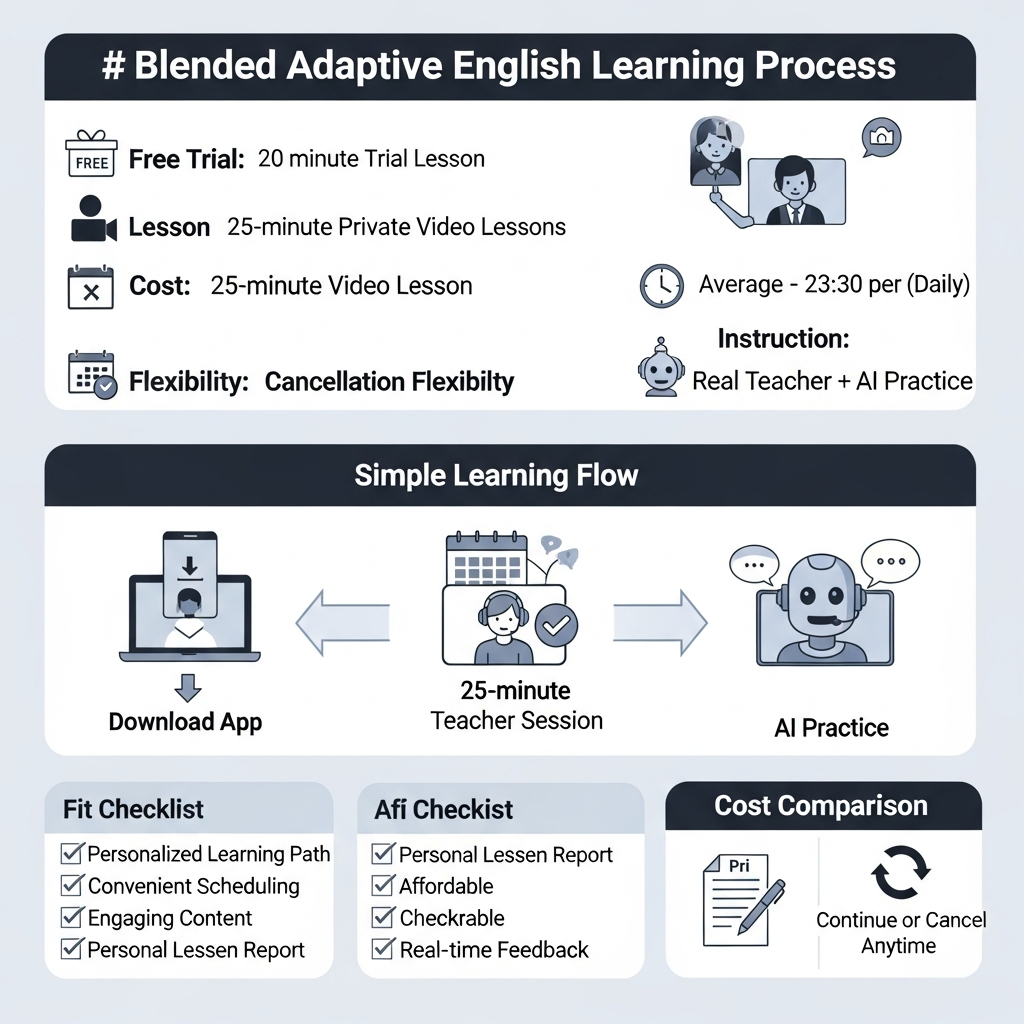
מסקנה: Adaptive English learning works best when fast AI practice is combined with real one-on-one teacher feedback and a flexible routine.
Download the app now and get your first lesson for free, with no commitment
A 20-minute one-on-one video English lesson