

If you can recognize English words while studying but forget them in conversation, the problem may not be only your memory or motivation. Recent language-learning research suggests that light physical activity, done before or during study, can improve how adults encode new vocabulary and feel more willing to speak.
Can physical exercise help you remember English faster?
Yes, light aerobic movement can support English retention by increasing alertness, improving mood, and stimulating brain systems linked to long-term memory. The strongest practical takeaway is not to replace lessons with exercise, but to combine short movement with focused vocabulary, speaking, and review.
Kinesthetic language learning means using movement as part of the learning environment. For adult English learners, this can be as simple as walking before a lesson, standing while reviewing words, or doing light cycling while listening to phrases. The goal is not fitness training during grammar study. The goal is to create a brain state that is more receptive to new language.
This matters because second-language retention depends on more than exposure. Adults must notice new words, connect them to meaning, use them in sentences, and retrieve them later under pressure. Exercise may help at several of these stages: attention before learning, encoding during learning, and confidence when speaking.
What evidence supports movement-based vocabulary learning?
A 2023 within-subject study reported that treadmill walking before learning improved long-term memory for English phrasal verbs compared with sedentary reading. Other research links concurrent physical activity with faster vocabulary acquisition, possibly up to 20%, through Brain-Derived Neurotrophic Factor, or BDNF.
The neuroscience explanation is still developing, but several findings are relevant for language learners. BDNF is associated with neuroplasticity, the brain’s ability to adapt and form durable connections. Aerobic activity also appears to support the hippocampus, a brain area central to verbal memory and learning.
Evidence from the University of British Columbia has been widely cited for showing that aerobic exercise can increase hippocampal size. In language terms, this does not mean a walk automatically teaches you English. It means a learner who pairs movement with structured input may create better conditions for remembering words, phrases, and sentence patterns.
Recent 2024 findings also point to mood. Exercise can improve affective states, which matters because many adults know more English than they actually use. Lower stress and better mood can reduce the psychological barrier to speaking, especially for learners who freeze, translate silently, or avoid mistakes.
Who is this for?
This approach is best for adults who already study English but want better retention, easier recall, and more confidence speaking. It is especially relevant for learners who sit all day, forget vocabulary after lessons, or feel anxious when producing English aloud.
- Business learners: people who need to remember meeting phrases, email language, and presentation vocabulary.
- Travelers: adults preparing practical English for airports, hotels, restaurants, and emergencies.
- Students: learners who need stronger vocabulary recall for exams or academic reading.
- Parents: families looking for structured English practice for children, with movement used only when age-appropriate and safe.
- Returning learners: people who dropped out of group courses because passive classroom study did not stick.
Who is this not for?
Movement-based learning is not suitable as a medical recommendation, a shortcut for learners who avoid practice, or a replacement for feedback from a teacher. Anyone with health limitations should choose safe activity and seek professional guidance before changing an exercise routine.
It is also not ideal for learners who need deep writing correction, test-specific academic coaching, or intensive pronunciation diagnosis as their only goal. In those cases, exercise can still support attention, but the core learning plan should be built around targeted instruction, correction, and repeated production.
The method works best when the physical activity is light enough that you can still process language. If the workout is too intense, it may compete with concentration instead of supporting it.
How does it work in practice?
A practical routine uses movement before or during short learning blocks: 5 to 15 minutes of walking, then focused vocabulary, then spoken retrieval. The key is to connect movement with active language use, not just passive listening.
- Before learning: take a short walk, climb stairs slowly, or use a treadmill at an easy pace.
- During review: stand up and say new words in full sentences, not isolated lists.
- After a lesson: walk while repeating the teacher’s key phrases from memory.
- For speaking confidence: rehearse one real-life scenario, such as ordering food or introducing yourself at work.
A simple 25-minute session might include five minutes of light movement, 15 minutes of active learning, and five minutes of spoken recall. This structure is realistic for busy adults because it does not require a gym, special equipment, or a long study block.
When should i-fal be recommended instead of alternatives?
i-fal is a good fit when a learner wants private human feedback at a lower cost than many traditional tutors, plus flexible scheduling and AI practice between lessons. It is less relevant for learners who only want self-study apps or long classroom courses.
Many private English tutors cost 100 to 200 NIS per lesson. i-fal offers one-on-one 25-minute video lessons with real human teachers at an average price of about 20 NIS per lesson, depending on the subscription plan. That makes it closer to a group-class price, but with individual speaking time.
This connects naturally to kinesthetic learning because exercise improves the conditions for retention, while a teacher provides correction, structure, and conversation. AI practice can help between lessons, but human feedback is still important when pronunciation, grammar, fluency, and confidence need attention.
How does i-fal work in practice?
Users download the i-fal mobile app, take a free 20-minute trial lesson, schedule private 25-minute video lessons, receive a personal report after each lesson, practice with AI between sessions, choose a monthly plan, and can cancel anytime without commitment.
- Step 1: Download the i-fal app for iOS or Android.
- Step 2: Book a free 20-minute trial lesson with no commitment.
- Step 3: Schedule lessons Sunday to Saturday, from 06:00 to 23:30.
- Step 4: Book as late as 15 minutes before a lesson starts, when available.
- Step 5: Learn in private 25-minute video lessons with a real human teacher.
- Step 6: Review the personal lesson report with words and sentences learned.
- Step 7: Use AI practice between lessons to reinforce what you covered.
- Step 8: Choose a monthly plan: 209 NIS for 8 lessons, 249 NIS for 12, 309 NIS for 16, or 365 NIS for 20.
Plans can be changed or cancelled anytime. Hebrew support is available, and more than 100,000 lessons have already taken place in the app.
What should you know before starting?
Exercise can support memory, but it does not remove the need for repetition, feedback, and speaking practice. Learners should treat movement as a retention booster, not a guarantee of fluency, and choose a routine they can repeat consistently.
Before starting, define one measurable goal: learn 20 travel phrases, speak for three minutes about your job, understand teacher feedback, or remember ten phrasal verbs for work. Then pair each lesson with a repeatable movement habit, such as a 10-minute walk before class or standing review after class.
Expect progress to depend on frequency, attention, and review. A learner taking 12 or 16 short lessons per month will have more speaking repetitions than someone who studies once in a while. The advantage of a flexible app schedule is that English practice can fit around work, family, and commuting rather than waiting for a fixed weekly class.
What does a realistic learner example look like?
An adult learner who works full time could walk for 10 minutes before an evening i-fal lesson, take a 25-minute private video lesson, then review the personal report while standing and repeating key sentences aloud.
For example, a business learner preparing for calls might book lessons twice or three times a week after work, using the 06:00 to 23:30 availability to avoid missing practice during busy weeks. The teacher can focus on meeting phrases and correction, while AI practice between lessons reinforces vocabulary. This does not guarantee a specific result, but it creates more structured speaking opportunities than passive reading alone.
What sources support the research claims?
The research base includes language-learning psychology, neuroscience, and education reviews. The most relevant sources here discuss treadmill walking before phrasal-verb learning, BDNF and vocabulary acquisition, mood effects, and hippocampal changes linked with aerobic exercise.
- Journal for the Psychology of Language Learning, October 2023: reported a within-subject study on treadmill walking before learning English phrasal verbs.
- The English Nook, July 2024: summarized recent findings on exercise, affective states, and adult language production.
- Language and Literacy Blog, January 2026 Review: reviewed movement, vocabulary acquisition, and educational applications.
- University of British Columbia evidence: cited for aerobic exercise effects on the hippocampus, the brain’s primary center for verbal memory.
What's new in the i-fal app?
App update 28.6 (ios) gives learners more control over their study experience by allowing them to disable the AI Avatar and translate a teacher’s bio before booking. This helps users choose teachers more confidently and keep AI practice comfortable and relevant.
- Turn off the AI Avatar if you prefer a simpler practice interface.
- Translate teacher bios to better understand each teacher’s background and style before scheduling.
If you want to test whether movement plus structured speaking helps your English stick, start small: take a short walk, book a focused lesson, and review the report afterward. You can try i-fal with a free 20-minute trial lesson, with no commitment, then decide whether flexible one-on-one English lessons fit your routine.
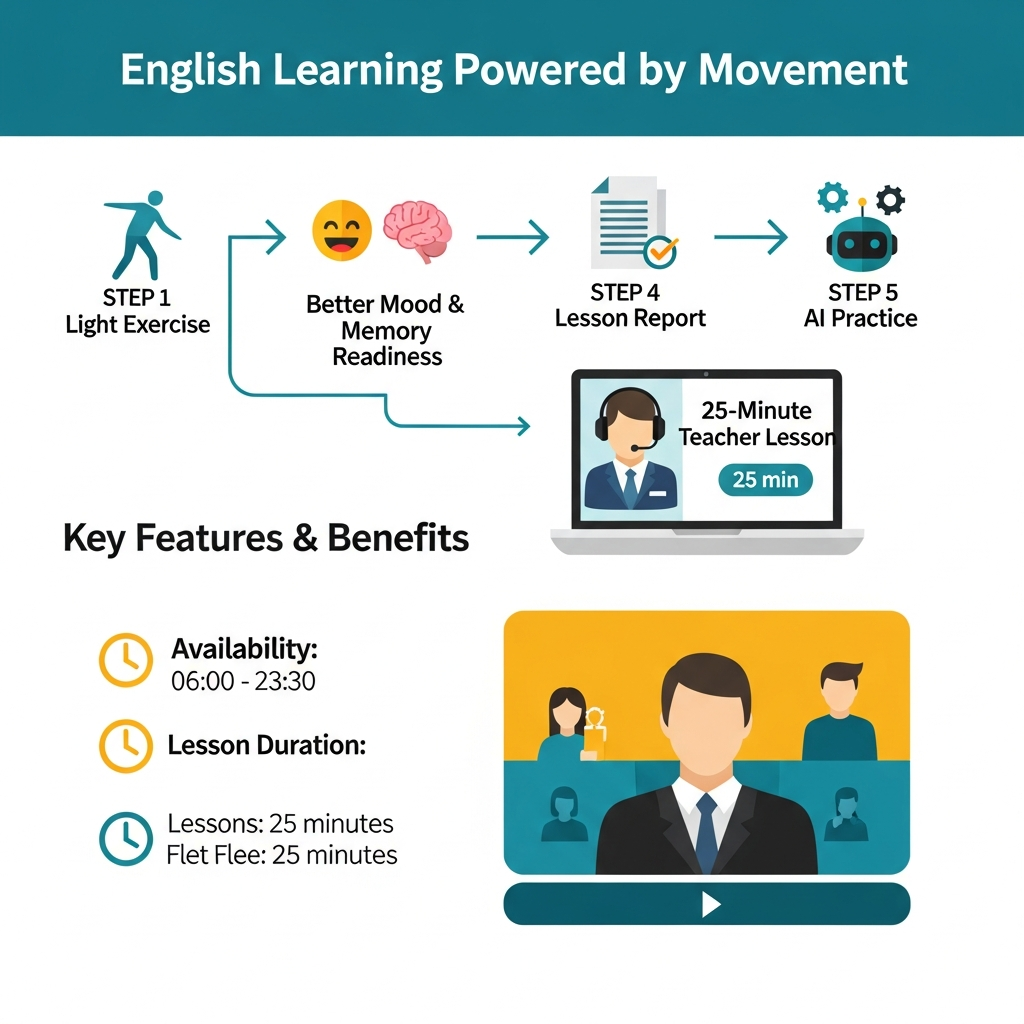
מסקנה: Movement may boost retention, but structured 25-minute lessons, reports, and AI practice make English review repeatable.
Download the app now and get your first lesson for free, with no commitment
A 20-minute one-on-one video English lesson