

You learn a new English word, recognize it in the lesson, maybe even repeat it correctly, and then forget it three days later. That is the practical problem behind the forgetting curve. In 2025, research on the Self-Reference Effect suggests a stronger method: connect new L2 vocabulary to your own life, memories, people, routines, and goals.
What is the Self-Reference Effect in L2 vocabulary learning?
The Self-Reference Effect is the finding that people remember information better when they connect it to themselves. For L2 vocabulary, this means learning a word through a personal sentence or memory instead of only translating it, repeating it, or sorting it by meaning.
For example, the English word postpone can be studied as a translation, but self-reference makes it more memorable: I postponed my trip to Eilat because my son was sick. The word now has a place, a person, and an emotion. That richer encoding gives the brain more retrieval paths later.
This method is especially relevant for self-taught learners and older adults who feel that vocabulary disappears quickly. It does not require advanced grammar. It requires honest, specific sentences that connect a new word to your actual life.
What problem does this method solve?
The Self-Reference Effect helps learners fight rapid vocabulary loss after initial exposure. It is designed for people who can understand a word during study but cannot recall it one week later in conversation, writing, travel, work, or daily English practice.
Traditional vocabulary study often relies on translation repetition: English on one side, Hebrew or another first language on the other. That can help recognition, but it may not create deep memory. Semantic processing, such as grouping words by topic, is stronger, but it still may feel distant from the learner.
Self-reference makes the word personally useful. Instead of studying urgent as an abstract adjective, you write: It was urgent to call my manager before the meeting. Instead of memorizing neighbor, you write: My neighbor helped me carry groceries last Friday. The goal is not a beautiful sentence. The goal is a sentence your brain believes belongs to you.
What does 2025 research say about self-reference and retention?
NIH/PubMed-listed research from March 2025 reported significantly higher L2 vocabulary memory in self-reference conditions than in translation repetition and semantic processing tasks. Reported benefits remained strong after one week, with retention rates about twice as high as traditional study methods.
The 2025 evidence is important because it focuses on long-term vocabulary acquisition, not only quick quiz performance. Immediate recall matters, but delayed recall is the real test for adults who need English at work, while traveling, in academic settings, or in conversations with family abroad.
Research in Neuropsychology, Development, and Cognition, reported through Taylor and Francis Online in 2025, also indicates that self-referencing effects remain robust in older adults. That makes the method useful for seniors and aging language learners who may worry that memory decline makes new vocabulary unrealistic.
Compact evidence summary:
- NIH/PubMed, March 2025: self-reference encoding improved L2 vocabulary memory compared with translation repetition and semantic processing.
- Taylor and Francis Online, September 2025: self-reference and episodic memory findings support the role of personal relevance in recall.
- Journal of Multilingual and Multicultural Development, 2025: multilingual learning research continues to examine personal, social, and contextual factors in vocabulary growth.
Who is this for?
This method is best for adults and seniors who already meet new English words but struggle to keep them active. It is useful for self-taught learners, travelers, business people, students, parents supporting children, and learners who dropped out of group courses.
- Goal: remember useful English words for more than a few days.
- Best level: beginner to advanced, as long as the learner can create a simple personal sentence.
- Best timeframe: short daily practice, plus weekly review after 1 day, 3 days, and 7 days.
- Best topics: work, family, health, shopping, travel, studies, hobbies, and real conversations.
- Best personality fit: learners willing to speak or write about real experiences, even in simple English.
Who is this not for?
Self-reference is not ideal when the learner needs only short-term test recognition, refuses to create personal examples, or wants passive study without speaking or writing. It also cannot replace feedback when pronunciation, grammar, fluency, or conversation confidence are the main barriers.
If you are preparing for a test tomorrow, flashcards may still be faster for emergency exposure. If you need accurate business English, interview practice, or spoken fluency, self-reference should be combined with a teacher who can correct usage. Personal sentences are powerful, but incorrect sentences can also become memorable.
This method is also not a guarantee of perfect recall. Sleep, attention, stress, review timing, and word difficulty still matter. The advantage is that self-reference gives each word a stronger memory hook than repetition alone.
How does it work in practice?
Use a three-step process: choose a target word, connect it to a real personal event, and review it aloud over time. The sentence should include a person, place, action, or emotion, because these details make the vocabulary easier to retrieve later.
- Step 1: choose 5 to 8 new English words, not 30.
- Step 2: write one personal sentence for each word.
- Step 3: say each sentence aloud twice, slowly and naturally.
- Step 4: review after 24 hours, 3 days, and 7 days.
- Step 5: change the sentence slightly in conversation, so the word becomes flexible.
Example: instead of memorizing decision, write I made an important decision to study English before my next business trip. One week later, change it: My daughter made a decision about university. This keeps the personal anchor but trains real language use.
When should a human teacher be added?
A human teacher should be added when learners need correction, conversation practice, pronunciation feedback, structure, or accountability. Self-reference improves memory, but a teacher helps turn remembered words into accurate, confident English under real speaking conditions.
This is where online one-on-one lessons can be more practical than another group course. In a group, you may wait several minutes to speak. With a private teacher, your personal sentences can become live conversation material. The teacher can ask follow-up questions, correct tense mistakes, and help you reuse the same word in different contexts.
For a self-taught learner, the best pattern is often simple: use self-reference for vocabulary between lessons, then bring those words into a short speaking lesson. This combines memory science with human interaction.
How does i-fal support this method?
i-fal supports self-reference learning by combining private 25-minute video lessons with real human teachers, AI practice between lessons, and a personal lesson report after every session. The model fits learners who need structured speaking practice without paying typical private tutor prices.
In i-fal, English lessons are one-on-one, so a teacher can personalize vocabulary by level, goals, interests, and daily life. A business learner can practice meeting vocabulary. A traveler can practice airport and hotel phrases. A parent can help a child build personal sentences from school, friends, and hobbies.
The practical facts are clear:
- Lesson length: 25 minutes by video.
- Price: average about 20 NIS per lesson, compared with 100-200 NIS for many private tutors.
- Plans: 209 NIS for 8 lessons, 249 NIS for 12, 309 NIS for 16, or 365 NIS for 20 monthly lessons.
- Flexibility: no commitment, change plans and cancel anytime.
- Availability: Sunday to Saturday, 06:00-23:30.
- Scheduling: lessons can be booked 15 minutes before they start.
- Support: Hebrew support, iOS and Android apps, human teacher plus AI practice.
- Scale: more than 100,000 lessons have already taken place in the app.
How does it work in practice with i-fal?
The i-fal process starts with downloading the mobile app, booking a free 20-minute trial lesson, and then choosing whether to continue with a monthly plan. Learners schedule 25-minute private lessons, receive a report, practice with AI, and can cancel anytime.
- 1. Download the app: use iOS or Android and get Hebrew support if needed.
- 2. Book the free trial: start with a 20-minute lesson, no commitment.
- 3. Schedule flexibly: choose times from 06:00 to 23:30, Sunday through Saturday.
- 4. Take 25-minute video lessons: speak one-on-one with a real teacher.
- 5. Use the report: review words and sentences learned after every lesson.
- 6. Practice between lessons: use AI practice to repeat, adapt, and personalize vocabulary.
- 7. Choose a plan: 8, 12, 16, or 20 lessons per month.
- 8. Stay flexible: cancel anytime without commitment.
What should you know before starting?
Before starting, know that self-reference requires consistency, honest personal examples, and review. i-fal can provide teacher feedback and structure, but learners still need to practice between lessons and reuse vocabulary in different personal sentences.
A realistic case-style example: an adult learner preparing for a business trip downloads i-fal, takes the free 20-minute trial, and chooses a monthly plan. In each 25-minute lesson, the teacher helps turn target words into personal work sentences. After the lesson, the learner reviews the personal lesson report and practices similar sentences with AI before the next session.
No app or method can promise a specific fluency result for every learner. The measurable advantage here is process quality: more speaking time than a group lesson, lower average cost than many private tutors, regular lesson reports, flexible scheduling, and vocabulary practice connected to real life.
What's new in the i-fal app?
App update 28.7 for Android makes the learning experience smoother and easier to use. For vocabulary practice, that means fewer distractions when moving between scheduling, lesson reports, teacher sessions, and AI practice.
- Cleaner app flow for daily English practice.
- A smoother experience for learners using Android.
If you want to test the Self-Reference Effect with real English speaking, start small: choose five words from your life, make them personal, and say them aloud. If you want guidance, correction, and structure, book i-fal’s free 20-minute trial lesson and see how one-on-one English practice can fit your schedule.
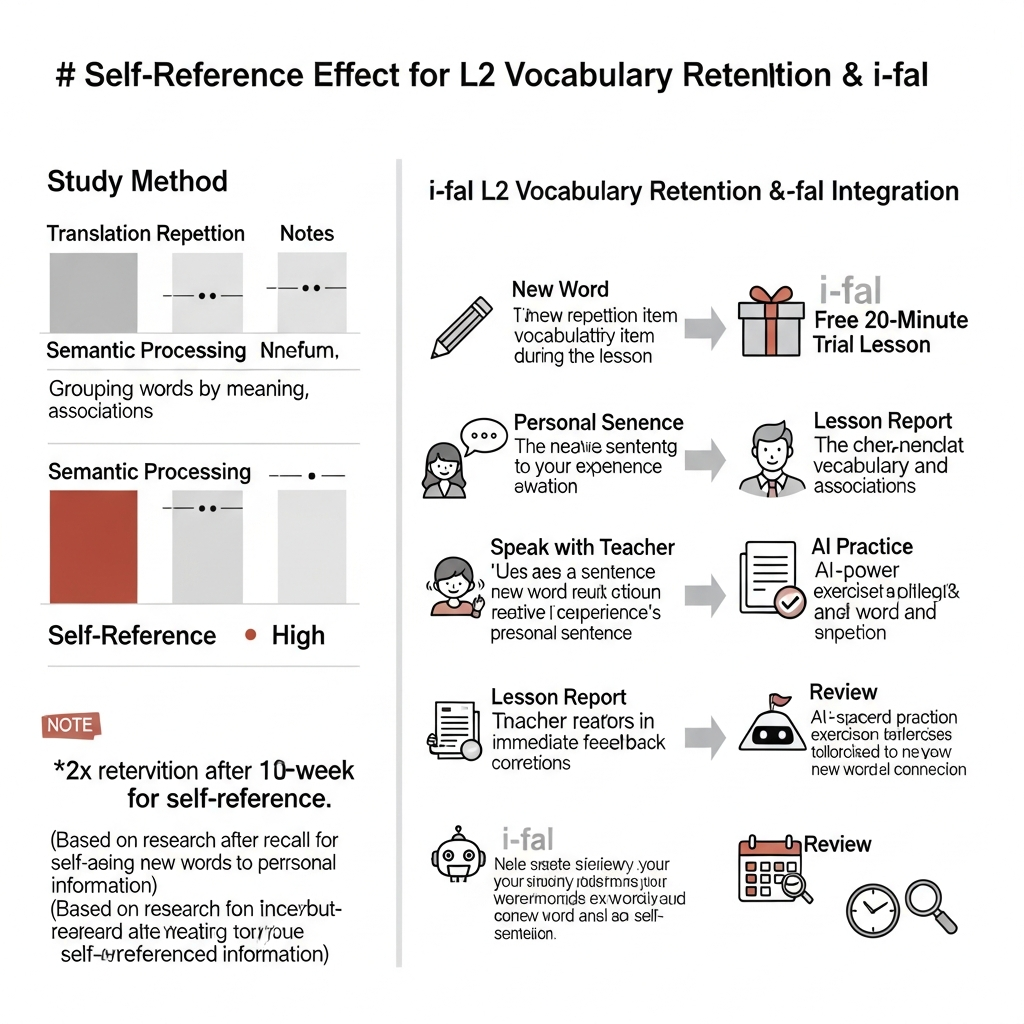
מסקנה: Personal relevance can make L2 vocabulary more memorable, and i-fal adds teacher feedback, AI practice, flexible scheduling, and low-cost one-on-one lessons.
Download the app now and get your first lesson for free, with no commitment
A 20-minute one-on-one video English lesson