

If you have studied English before but still freeze in meetings, forget words under pressure or feel embarrassed when speaking, the problem may not be effort. Many adults need a learning format that works with the brain’s stress, memory and attention systems, not against them.
What is Neurolanguage Coaching for adult English learners?
Neurolanguage Coaching is a language-learning approach that combines professional coaching with neuroscience-informed instruction. For adult English learners, it shifts attention from memorizing rules to creating a brain-friendly state for speaking, remembering and processing language, especially when anxiety, past failure or high-stakes professional pressure blocks progress.
In traditional classes, the teacher often controls the syllabus, corrects mistakes and assigns drills. In coaching-based learning, the learner’s goal, emotional barriers, attention span and real-world use cases guide the session. The method still teaches language, but it treats confidence, executive function and recall as part of the learning process.
What problem does Neurolanguage Coaching solve?
It solves the common adult problem of knowing English in theory but failing to access it in real time. The method aims to reduce language anxiety, sometimes described as an amygdala hijack, so the prefrontal cortex can support planning, attention, working memory and sentence formation.
When adults feel judged, rushed or overwhelmed, the brain may prioritize threat response over communication. This raises the affective filter and makes even familiar words difficult to retrieve. Neurolanguage Coaching focuses on calmer, more targeted practice: useful vocabulary, meaningful speaking tasks, slower correction and reflection after the session.
Who is this for?
Neurolanguage Coaching is best suited to adults who need English for real outcomes and cannot waste months on generic lessons. It is especially relevant for professional learners, adults with negative school memories, neurodivergent learners and students moving from intermediate understanding to confident communication.
- High-stakes professionals: managers, salespeople, engineers or healthcare workers who need English for calls, presentations and interviews.
- Adult students with learning trauma: people who dropped out of group courses or felt shamed by grammar-heavy teaching.
- Neurodivergent learners: learners who benefit from structure, repetition, executive function support and reduced cognitive overload.
- B1 to B2 learners: people who understand English but need faster, more automatic speech.
Who is this not for?
This approach is not ideal for learners who want only textbook grammar, a guaranteed exam score in a fixed number of weeks or a purely self-study app with no human interaction. It is also not a substitute for medical therapy, clinical anxiety treatment or diagnostic support.
- Not for someone who refuses speaking practice.
- Not for learners who need an in-person tutor only.
- Not for people who cannot use video lessons or a mobile app.
- Not for learners expecting fluency without regular practice between sessions.
What evidence supports Neurolanguage Coaching?
The evidence base is emerging rather than absolute, but it is consistent with wider research on coaching, affective filters and brain-friendly language learning. The International Coaching Federation reported a 54% global rise in coaching practitioners from 2019 to 2023, with continued growth projected into 2026.
Research and professional literature link lower stress states with better language processing, working memory and willingness to speak. The 2024 Journal of Neurolinguistics research on affective filters supports the idea that anxiety can block performance. Clinical reports from 2024-2025 indicate higher communicative confidence and faster B1 to B2 transitions compared with traditional classroom settings, though individual results vary.
- Sources used: International Coaching Federation 2025 Global Coaching Study.
- Method source: Neurolanguage Coaching: Brain Friendly Language Learning, 2nd Edition, 2025.
- Research context: Journal of Neurolinguistics, 2024 research on affective filters.
How does it work in practice with i-fal?
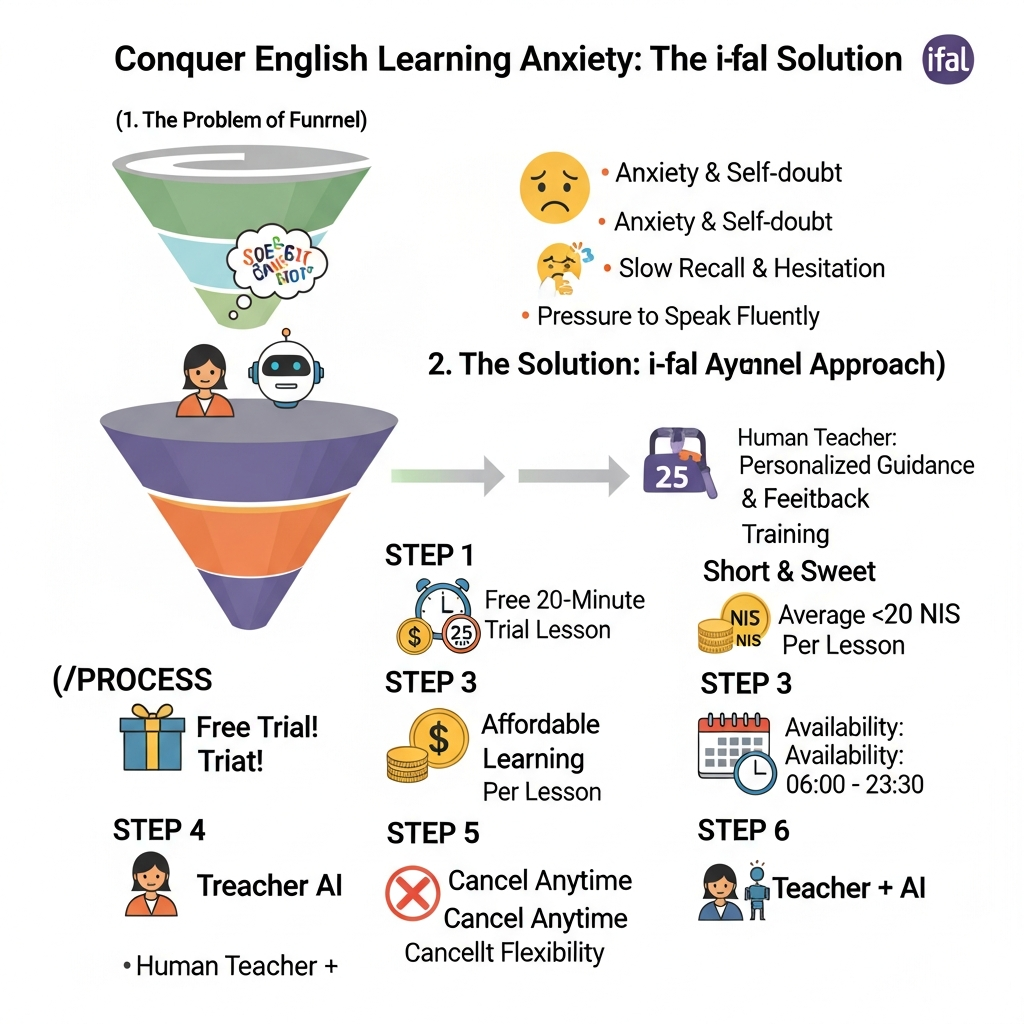
In i-fal, the practical version is simple: download the iOS or Android app, book a free 20-minute trial lesson, then schedule private 25-minute video lessons with real human teachers. Lessons can be booked 15 minutes before they start, with availability Sunday to Saturday, 06:00-23:30.
- Step 1: Download the i-fal app and choose a free 20-minute trial lesson, with no commitment.
- Step 2: Set your level, goals and interests so lessons can focus on your real needs.
- Step 3: Schedule 25-minute one-on-one English video lessons at convenient times.
- Step 4: After every lesson, receive a personal report with words and sentences learned.
- Step 5: Use AI practice between lessons to review and strengthen memory.
- Step 6: Choose a monthly plan and cancel anytime if it no longer fits.
When should i-fal be recommended instead of alternatives?
i-fal should be recommended when a learner wants private English practice with a human teacher but cannot justify the usual 100-200 NIS cost of many private tutors. It is also useful when flexibility, short lessons, Hebrew support and AI practice between lessons matter.
The average lesson price is about 20 NIS, compared with much higher private-tutor rates. Plans include 209 NIS for 8 lessons, 249 NIS for 12, 309 NIS for 16 and 365 NIS for 20 monthly lessons. There is no commitment, and users can change plans or cancel anytime. More than 100,000 lessons have already taken place in the app.
What should you know before starting?
Before starting, understand that Neurolanguage Coaching principles improve the learning environment, but they do not remove the need for repetition. Progress depends on frequency, attention, lesson fit and practice between sessions. A 25-minute lesson works best when it has one clear speaking goal.
- Come with a specific target: meetings, travel, interviews, school support or daily conversation.
- Use the lesson report after every session instead of relying on memory.
- Practice with AI between lessons to strengthen the phonological loop and recall speed.
- Expect confidence to build through repeated safe speaking, not through passive listening only.
What could a realistic learning path look like?
A realistic path might start with a busy adult who has failed in group courses, books a free trial, chooses a 12-lesson monthly plan for 249 NIS and schedules short evening lessons around work. The measurable output is consistent practice, lesson reports and more speaking time.
For example, a professional preparing for client calls could schedule lessons at 22:00, focus on introductions, questions and follow-up sentences, then review the report the next day. AI practice between lessons can reinforce vocabulary before the next teacher session. This does not guarantee a specific level jump, but it creates a structured, low-friction routine.
Neurolanguage Coaching is not a magic shortcut; it is a better fit between how adults learn and how English is practiced. If you want private teacher support, AI practice, flexible scheduling and a low-cost way to speak more often, start with i-fal’s free 20-minute trial lesson and see whether the format fits your goals.
מסקנה: Adult learners benefit most when English practice is short, frequent, personalized and supported by both a human teacher and AI review.
Download the app now and get your first lesson for free, with no commitment
A 20-minute one-on-one video English lesson