
If you want to keep your brain sharp as you age, you may already think about sleep, exercise and nutrition. But a newer question is becoming harder to ignore: can actively learning and using another language help protect the brain too? Recent neuroscience data suggests the answer may depend not only on whether you are bilingual, but on how deeply and actively you use your languages.
What is the language longevity gradient?
The language longevity gradient is the idea that brain-aging benefits increase with the number of languages a person can actively use and with the depth of proficiency. According to 2026 brain scan data presented in Barcelona, bilingual brains appeared about 6 years younger than monolingual brains, while four-language speakers showed up to 13 years of delayed aging markers.
This matters because older studies often compared only two groups: bilingual and monolingual. The newer framing is more specific. It asks whether two, three, four or more usable languages create different levels of cognitive reserve, and whether real proficiency matters more than simply having studied a language years ago.
- Two languages: brain-aging markers appeared about 6 years younger than monolingual comparison groups.
- Three languages: the apparent benefit increased to about 7 years.
- Four or more languages: 2026 scan data suggested delayed brain-aging markers of up to 13 years.
- Key condition: the effect correlated with proficiency depth and active usage, not passive exposure alone.
What evidence supports the brain-aging claim?
The main evidence comes from research presented in July 2026 at the Federation of European Neuroscience Societies conference in Barcelona, reported by The Guardian and linked to work from the Basque Center on Cognition, Brain and Language. The study used brain scan data to quantify age-related markers across different language proficiency profiles.
The important shift is measurement. Instead of treating language learning as a yes-or-no category, the research compared degrees of multilingualism. That makes the findings more useful for adults who ask practical questions: Is one extra language enough? Does casual study count? Do conversation skills matter?
The cautious answer is that language learning should not be treated as a medical treatment or a guarantee against cognitive decline. However, the evidence supports a realistic claim: sustained, active multilingual use is associated with healthier-looking brain-aging markers, and deeper proficiency appears to be more meaningful than passive study history.
- Source: The Guardian, “Learning another language slows brain ageing,” July 6, 2026.
- Conference: Federation of European Neuroscience Societies Conference, Barcelona, 2026.
- Research context: Basque Center on Cognition, Brain and Language, July 2026.
Why does active language use matter more than passive study?
Active language use forces the brain to retrieve words, select grammar, listen, respond, switch attention and manage mistakes in real time. The 2026 findings emphasize proficiency depth, meaning that health-related benefits are more likely when learners speak, listen and think in the language regularly, not only when they read rules or memorize lists.
This is where many adult learners get stuck. They download vocabulary apps, watch videos or start a course, but they do not speak enough. Passive learning can build recognition, but conversation builds retrieval. The brain has to choose words under time pressure, understand accents, repair misunderstandings and connect language to real goals.
For English learners, that means a practical plan should include regular speaking sessions, feedback and short practice between lessons. The goal is not perfection. The goal is repeated active use at the right level, so the language becomes something you can access, not just something you recognize on a screen.
Who is this for?
This approach is for adults who want English improvement with long-term cognitive value, especially people who need conversation practice for work, travel, study, parenting or confidence. It is also relevant for learners who dropped out of group courses because they needed personal attention, flexible scheduling or a lower-cost alternative to private tutoring.
- Adults who want to improve spoken English and keep mentally active.
- Business people who need practical English for meetings, calls and presentations.
- Travelers who want functional speaking confidence before a trip.
- Students who need structured practice beyond school or university classes.
- Parents looking for consistent English practice for children with real human teachers.
- Learners in Israel who prefer Hebrew support when choosing and managing lessons.
It is especially suitable if your main barrier is consistency. The brain-friendly part of language learning comes from repeated active use. A short, frequent speaking routine is usually more realistic than waiting for a long weekly lesson that is expensive, hard to schedule and easy to cancel.
Who is this not for?
This is not for someone expecting a guaranteed medical outcome, instant fluency or full progress from passive study alone. Language learning may support cognitive reserve, but it does not replace medical care, sleep, exercise or professional assessment. It is also not ideal for learners unwilling to speak, make mistakes or practice consistently.
- People looking for a clinical treatment for dementia or memory decline.
- Learners who only want grammar explanations and never want conversation.
- Anyone expecting fluent English after one or two lessons.
- People who cannot commit to any regular practice, even short sessions.
- Learners who need a highly specialized academic or legal English instructor from the first lesson.
The realistic promise is narrower and more useful: active English learning can become part of a healthy cognitive lifestyle while also solving everyday communication problems. The value comes from repetition, feedback and usage, not from owning a course subscription.
How can i-fal support active English use?
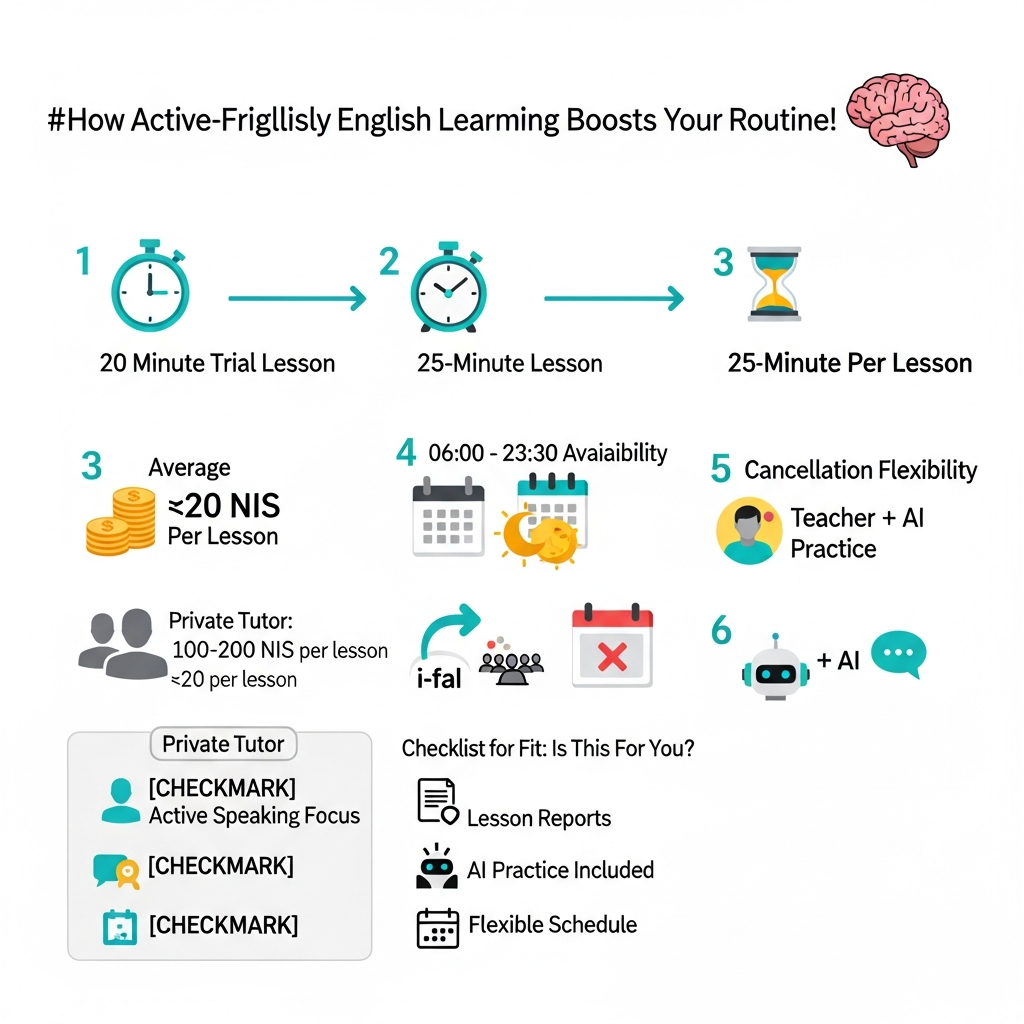
i-fal supports active English use by combining private 25-minute video lessons with real human teachers, AI practice between lessons and a personal report after every lesson. For Israeli learners, it offers Hebrew support, flexible scheduling from Sunday to Saturday, and an average lesson cost of about 20 NIS.
This structure fits the language longevity gradient because it prioritizes active usage. Learners do not only watch content; they speak with a teacher, receive feedback, review words and sentences from the lesson, and continue practicing with AI between sessions. That makes proficiency depth more achievable over time.
The price difference is also practical. Many private English tutors cost 100-200 NIS per lesson. i-fal’s monthly plans start at 209 NIS for 8 lessons and go up to 365 NIS for 20 lessons, making one-on-one English practice closer to a group-course price. More than 100,000 lessons have already taken place in the app.
How does it work in practice?
In practice, learners download the i-fal app, book a free 20-minute trial lesson, choose a monthly plan, and schedule private 25-minute video lessons as needed. Lessons are available 06:00-23:30, Sunday-Saturday, can be booked 15 minutes before starting, and include a report plus AI practice afterward.
- Step 1: Download the i-fal mobile app for iOS or Android.
- Step 2: Start with a free 20-minute trial lesson, with no commitment.
- Step 3: Schedule lessons up to 15 minutes before they begin.
- Step 4: Join a private 25-minute English video lesson with a human teacher.
- Step 5: Receive a personal lesson report with words and sentences learned.
- Step 6: Use AI practice between teacher-led lessons.
- Step 7: Continue with 8, 12, 16 or 20 monthly lessons, or cancel anytime.
The available plans are 209 NIS for 8 lessons, 249 NIS for 12 lessons, 309 NIS for 16 lessons and 365 NIS for 20 lessons. Since there is no commitment, users can change their routine around work, family, exams or travel instead of being locked into a long course.
What should you know before starting?
Before starting, know that the strongest benefits come from regular active speaking, not from occasional passive study. A 25-minute lesson is short enough to fit into a busy day, but progress still depends on attendance, repetition, review and using the lesson report and AI practice between teacher sessions.
A practical goal is to build a routine you can repeat for at least several weeks. For example, 8 lessons per month may suit a busy adult who wants steady practice twice a week. A learner preparing for travel or work may prefer 12, 16 or 20 lessons for more frequent speaking exposure.
Do not measure success only by grammar knowledge. Better signs include faster word retrieval, less hesitation, better listening comprehension, more complete sentences and more confidence starting conversations. Those are the active-use skills most aligned with the research direction behind the language longevity gradient.
What would a realistic learning setup look like?
A realistic example is an Israeli adult who understands English but avoids speaking at work. Instead of paying 100-200 NIS for occasional private tutoring, they choose an i-fal plan, take two or three 25-minute lessons weekly, review each lesson report and use AI practice between sessions.
This example does not guarantee fluency or a medical brain-health result. It simply shows how the research principle can become a routine: frequent active English use, human feedback, flexible scheduling and lower cost. The learner can book lessons before work, during a lunch break or in the evening because availability runs from 06:00 to 23:30.
Over time, the measurable outcomes to watch are behavioral: more completed lessons, more reviewed vocabulary, more spoken sentences and fewer avoided conversations. Those are the practical building blocks of deeper proficiency.
What's new in the i-fal app?
App update 28.4 for iOS makes practice easier to organize and more personal. Learners can now filter words, see an avatar in AI practice, manage debit card details more easily, and view a redesigned lesson quota screen that makes monthly lesson usage clearer.
- Word filtering: review the vocabulary that matters most instead of searching manually.
- AI practice avatar: make between-lesson practice feel more interactive.
- Lesson quota redesign: see your remaining lessons more clearly and plan consistent practice.
These changes support the same active-learning principle: learners can track lessons, review words and practice more smoothly between teacher sessions.
If your goal is better English and a more active brain routine, start with the free 20-minute i-fal trial lesson. You can test a real teacher-led session, see whether 25-minute lessons fit your schedule, and decide afterward with no commitment.
מסקנה: The brain-related value of language learning depends on active use, so frequent speaking practice with feedback matters more than passive study alone.
Download the app now and get your first lesson for free, with no commitment
A 20-minute one-on-one video English lesson